
HACCP for ready-to-eat catering has to account for everything that happens after the kill step: portioning, plating, chilled holding, carts, dishware and the people moving between them. When exposed food is handled after cooking, sanitation and Listeria controls must work in practice, not just on paper.
Ready-to-eat operations move products, people, equipment and packaging between preparation, chilled holding and distribution. In addition, temperature monitoring, documented deviations and verified corrective actions are central to keeping unsafe food from leaving the building.
Quick answer
A HACCP-based review of ready-to-eat catering should identify risks from post-process contamination, cross-traffic and temperature abuse. Then it should select scientifically supported controls and monitoring. Not every sanitation measure is a HACCP critical control point. Depending on the operation, the framework may be 21 CFR Part 117 for registered food facilities, or state and local codes based on the FDA Food Code for food service.
Who this article is for
This guide is written for commercial kitchens, airline caterers, central kitchens and ready-to-eat food processors evaluating hazard controls.
1. Map the complete food and equipment flows
Document cooking, cooling, chilled holding, portioning, plating and transport. Also include the return of dishware and carts, because returning equipment can carry contamination back into clean areas. Mark every step where exposed food could be contaminated after a kill step. See hygienic zoning assessment for separating these flows.
2. Characterize environmental Listeria risk
Where foods are exposed, evaluate traffic, drains, refrigeration structures, utensils and food-contact surfaces as possible contamination routes. Listeria monocytogenes can persist in damp, hard-to-clean niches. For facilities under Part 117, sanitation controls cover food-contact surfaces and prevention of cross-contamination (21 CFR 117.135(c)(3)). Environmental monitoring is a verification activity when RTE food could be contaminated with an environmental pathogen (21 CFR 117.165(a)(3)). Our article on Listeria and environmental contamination in RTE foods goes deeper on sampling.
3. Evaluate temperature exposure throughout holding
Review the cumulative time in refrigerated storage, including any period without monitoring. Then define adequate methods, frequencies and deviation criteria. A cold room that recovers its set point does not erase the time the food spent warmer.
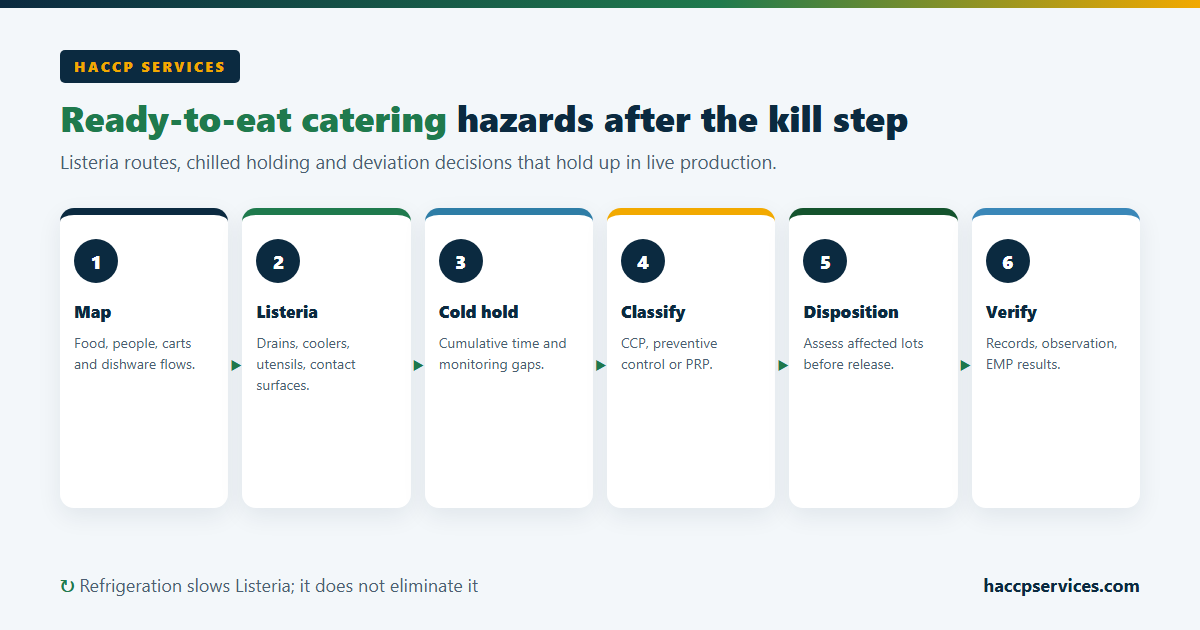
4. Distinguish CCPs from other necessary controls
Use the applicable regulatory framework and the hazard analysis to decide which measures are CCPs, prerequisite programs or preventive controls. Cold holding may be a CCP in one plan and a process control in another. See HACCP critical control points for the decision logic.
5. Document deviation and product disposition
Assess affected lots, temperature history, possible exposure and the limits of any testing. Avoid releasing product only because refrigeration was restored. Under Part 117, corrective actions must evaluate all affected food for safety and keep it out of commerce if safety cannot be assured (21 CFR 117.150). Our guide to HACCP deviation handling and product disposition walks through the decision.
6. Verify corrective actions and update the plan
Use records, direct observation and relevant verification results to confirm that changes prevent recurrence. Then update the hazard analysis and procedures if the deviation revealed a gap.
Frequently asked questions
Does every Listeria control have to be a CCP?
No. Control classification depends on the hazard analysis, process design and applicable food safety regulations.
Can refrigeration eliminate Listeria contamination?
No. Refrigeration may slow growth, but it does not reliably eliminate the organism. Listeria can grow at refrigeration temperatures.
What should happen when a cold-room monitoring gap occurs?
Review the affected food and the available time-temperature evidence. Then document the deviation and decide disposition under your procedures.
Ready-to-eat catering checklist
- Map exposed-food processing and possible contamination routes.
- Check that control procedures are followed during live production.
- Document risk-based monitoring methods, frequencies and records.
- Define investigation and product-assessment steps for deviations.
- Verify corrective-action effectiveness before closing the record.
How HACCP Services can help
HACCP Services, a service of Consultare Inc. Group, supports HACCP plan development and review, process mapping, sanitation assessment, cold-chain evaluation, verification design and corrective-action support. Services and deliverables depend on the agreed engagement scope and the requirements that apply to each facility.
- Commissaries and central kitchens HACCP plans
- Environmental monitoring program design
- Cold storage and distribution HACCP plans
- Product hold, release and disposition
Need help with your ready-to-eat HACCP controls?
Discuss your facility, products, hazards, current procedures and improvement priorities with our team. You can book a free consultation or contact our team.
Start building your compliance system
If you prefer to organize and manage your compliance activities yourself, you can also create a free SystemsBuilder account. Then begin building a structured system for your compliance documentation and processes.
Technical sources: 21 CFR Part 117 (CGMP and Preventive Controls for Human Food), FDA Draft Guidance: Control of Listeria monocytogenes in Ready-To-Eat Foods and the FDA Food Code. This article is educational; HACCP Services is not affiliated with FDA, and specific requirements depend on your products, processes and applicable regulations.