
HACCP plan vs FDA food safety plan: food manufacturers often use the two terms interchangeably, but U.S. regulation treats them differently. The framework that applies depends on the food, the operation and its regulatory pathway. A covered juice processor, a seafood processor, a meat or poultry establishment and another FDA-regulated facility may each have different requirements.
Before preparing or revising a plan, identify the applicable regulation and any exemption or modified requirement. In addition, do not mistake a retailer’s request for a “food safety plan” or a certificate for the wording of a federal regulation.
Quick answer
A HACCP plan controls hazards at critical control points and is required by regulation for covered juice (21 CFR Part 120), seafood (Part 123) and meat and poultry (9 CFR Part 417) operations. An FDA food safety plan under 21 CFR Part 117 covers hazard analysis and risk-based preventive controls for most other FDA-registered food facilities. It must be prepared or overseen by a preventive controls qualified individual (PCQI).
Who this article is for
This guide is for food manufacturers, PCQIs, HACCP coordinators and quality managers deciding which plan their products and processes need.
1. Understand the HACCP approach
HACCP is a systematic method for identifying and evaluating hazards and for establishing controls at points where control is essential to food safety. Internationally, its principles are set out in the Codex General Principles of Food Hygiene (CXC 1-1969). A HACCP plan is specific to the product, process and facility. Our HACCP principles page covers the seven principles.
Certain U.S. sectors have their own HACCP regulations. Examples include covered juice processors under 21 CFR Part 120 and seafood processors under 21 CFR Part 123. Meat and poultry establishments regulated by USDA FSIS follow 9 CFR Part 417.
2. Understand FDA preventive controls under Part 117
FDA’s preventive controls rule for human food, 21 CFR Part 117, requires covered facilities to conduct a hazard analysis. Where it identifies hazards requiring a preventive control, the facility must implement risk-based preventive controls.
Under 21 CFR 117.126, the written food safety plan includes the hazard analysis and preventive controls. It also includes the supply-chain program and recall plan where required, plus monitoring, corrective action (117.150) and verification (117.165) procedures. A PCQI must prepare or oversee the plan and has other duties listed in 21 CFR 117.180.
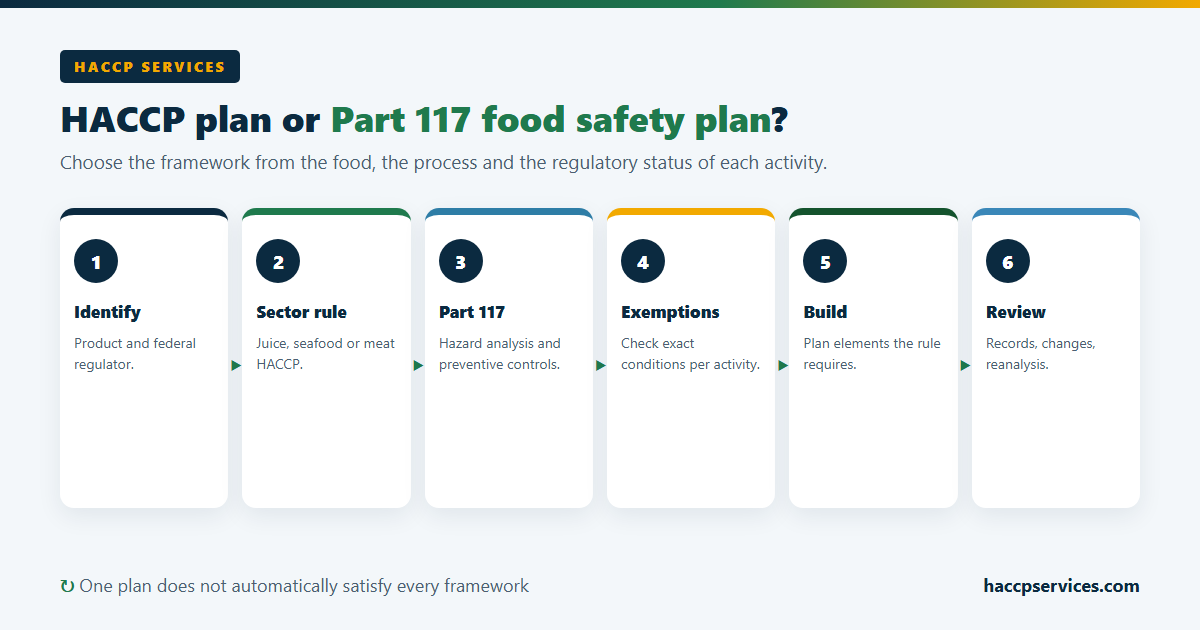
3. Determine which framework applies to the operation
Review the product type, process, facility activities and regulatory status. Under 21 CFR 117.5, activities subject to Juice HACCP or Seafood HACCP are exempt from the Part 117 hazard analysis and preventive controls requirements (subparts C and G). However, this applies only if the facility is required to comply, and does comply, with Part 120 or Part 123 for those activities.
Do not assume that one plan automatically satisfies every framework at a multi-product facility. Instead, separate products and processes where their regulations or hazards differ.
4. Compare the required plan elements and records
Both approaches rely on hazard identification and effective controls. Even so, their structure, terminology and required elements are not identical. Review the applicable regulation and official guidance before deciding what your plan must contain. Our HACCP hazard analysis guide is a useful starting point.
Records should show that controls are implemented and reviewed. Depending on the framework, this may include monitoring, corrective actions, verification, validation where required, supplier controls, training, and reassessment or reanalysis. See HACCP verification and validation requirements.
5. Align the plan with actual production and retailer needs
Verify process flow diagrams on site. Then assess ingredients, equipment, processing conditions, packaging, storage and distribution. Review changes to formulations, suppliers, equipment or process parameters for their effect on hazards and controls.
Costco or another retailer may request certifications, audit reports, product specifications or additional supplier records. Confirm those requirements directly with the buyer and keep them separate from legal requirements. For supplier-focused guidance, see HACCP requirements for food manufacturers preparing to sell at Costco and is HACCP certification required to become a Costco food supplier.
Frequently asked questions
Is an FDA food safety plan the same as a HACCP plan?
No. Both start from a hazard analysis, but a Part 117 food safety plan uses preventive controls and has different required elements from a sector HACCP plan.
Does a juice or seafood HACCP plan also satisfy Part 117?
For those specific activities, 21 CFR 117.5 exempts them from the Part 117 preventive controls requirements, provided the facility is required to comply and does comply with Part 120 or Part 123. Other activities at the site still need their own assessment.
Who must prepare a Part 117 food safety plan?
One or more preventive controls qualified individuals must prepare it or oversee its preparation, under 21 CFR 117.126(a)(2).
HACCP plan vs food safety plan checklist
- Identify the product category and the applicable federal regulator.
- Determine whether a sector-specific HACCP rule or Part 117 applies.
- Check exemptions and modified requirements against the exact operation.
- Develop a plan specific to the actual process and hazards.
- Verify monitoring, corrective action, verification and record review arrangements.
- Confirm any additional Costco supplier documentation requests.
How HACCP Services can help
HACCP Services, a service of Consultare Inc. Group, supports regulatory pathway reviews, HACCP plan development, Part 117 food safety plan support, hazard analysis, process flow verification, documentation review and internal audit preparation, subject to the engagement scope. The correct scope depends on your facility’s actual products and operations.
- HACCP plan development
- Seafood HACCP plans (21 CFR 123)
- Juice HACCP plans (21 CFR 120)
- Meat and poultry HACCP plans (USDA FSIS)
Not sure whether you need HACCP or a Part 117 food safety plan?
Discuss your product, process, facility activities and existing food safety documentation with our team. You can book a free consultation or contact our team.
Start building your compliance system
If you prefer to organize and manage your compliance activities yourself, you can also create a free SystemsBuilder account. Then begin building a structured system for your compliance documentation and processes.
Technical sources: FDA Preventive Controls for Human Food, 21 CFR 117.126 (Food safety plan), FDA Juice HACCP Hazards and Controls Guidance, FDA Fish and Fishery Products Hazards and Controls Guidance and 9 CFR Part 417 (USDA FSIS HACCP). This article is educational; HACCP Services is not affiliated with or endorsed by Costco Wholesale, FDA or USDA. Costco-specific supplier requirements must be confirmed directly with the relevant Costco contact, and regulatory applicability depends on your products, processes, facility and current law.