
A bakery hazard analysis has to cover more than the ingredients on the recipe card. It also needs the hazards introduced by shared lines, worn equipment and handling after baking.
Sesame is a current example. It became the ninth major food allergen in the U.S. on January 1, 2023, and bakeries that run sesame-topped and sesame-free products on the same lines face real cross-contact and labeling risk. Hazard analysis gives you a structured basis for choosing controls instead of relying on final inspection alone. In addition, under FDA’s preventive controls rule (21 CFR Part 117), many bakery controls are allergen or sanitation preventive controls rather than HACCP critical control points.
Who this article is for
This guide is written for bakery HACCP teams, production leaders and food safety managers.
1. Draw a realistic process flow
Map receiving, storage, mixing, forming, baking, cooling, slicing, handling, packing and distribution. Then verify the flow on the floor, including rework routes. Our HACCP hazard analysis guide explains each step.
2. Evaluate undeclared-allergen hazards
Assess allergen-containing formulas, line sharing, changeovers, glove use, rework, trays and labeling. An allergen matrix by product and line makes gaps visible. See allergen management program development.
3. Assess equipment-related foreign material
Inspect contact surfaces and deteriorating metal parts such as mixer blades, sheeter rollers and slicer blades. Then decide on inspection, maintenance, metal detection or other controls. See foreign material control.
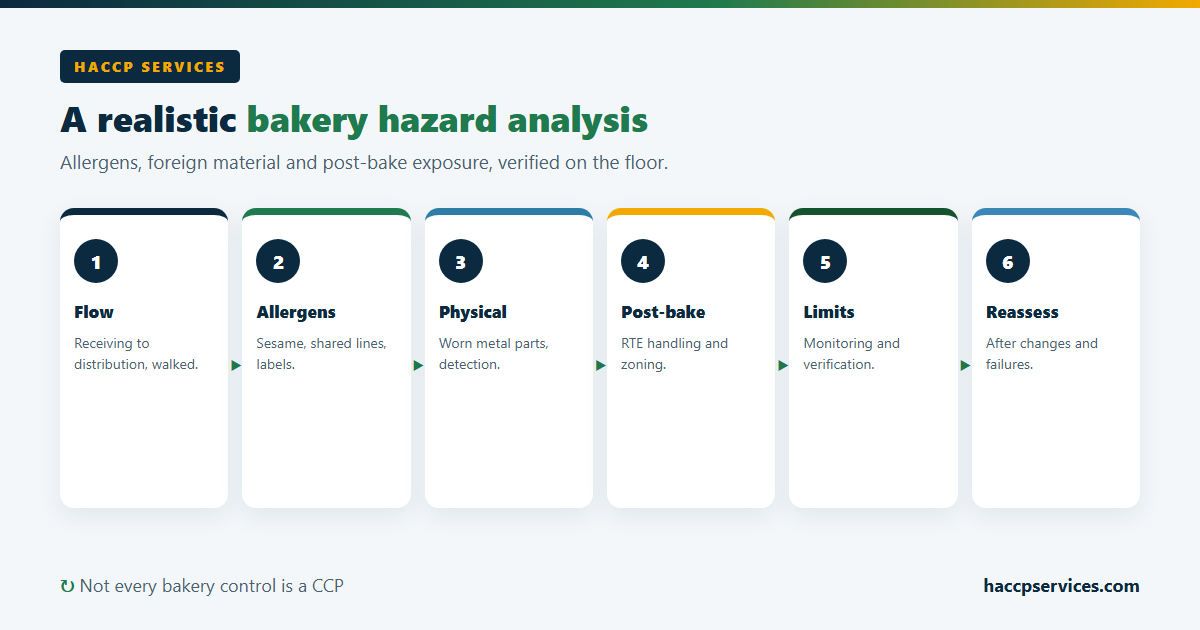
4. Review ready-to-eat exposure after baking
Baking is a kill step, but cooled, sliced, filled or iced products are exposed again. Therefore, evaluate whether post-bake handling needs sanitation, hygienic zoning or other measures. Our companion article on post-bake contamination covers these controls in depth.
5. Set justified limits and verification
Where a control applies, specify monitoring, acceptance criteria, responsible people, deviation response and supporting evidence. For CCPs, see HACCP critical limits.
6. Reassess after nonconformities or changes
Evaluate affected lots, update the hazard analysis after recipe, supplier or equipment changes, and use corrective action records to confirm effectiveness.
Frequently asked questions
Is every bakery control a HACCP critical control point?
No. Many are allergen or sanitation preventive controls or prerequisite programs, depending on the hazard analysis.
Why include sesame specifically?
Sesame has been a major food allergen in the U.S. since 2023, so it must be declared and controlled like the other eight.
Does final inspection replace hazard analysis?
No. Inspection supports control but cannot reliably find undeclared allergens or all foreign material.
Bakery hazard analysis checklist
- Is the allergen matrix and recipe approval current?
- Are production scheduling and changeovers documented?
- Are packaging and label versions verified against the recipe?
- Are training, inspections and corrective actions documented?
How HACCP Services can help
HACCP Services, a service of Consultare Inc. Group, supports bakery hazard analysis, allergen and foreign material programs, HACCP plan development and corrective action procedures, subject to the engagement scope and applicable requirements.
Need help with your bakery HACCP plan?
Discuss your products, processes and documentation with our team. You can book a free consultation or contact our team.
Start building your compliance system
If you prefer to organize and manage your compliance activities yourself, you can also create a free SystemsBuilder account. Then begin building a structured system for your compliance documentation and processes.
Technical sources: 21 CFR Part 117 (CGMP and Preventive Controls for Human Food) and FDA Food Allergies. This article is educational; HACCP Services is not affiliated with FDA, and specific requirements depend on your products, processes and applicable regulations.