
Post-bake contamination is the main food safety risk for many baked goods, because the oven kills pathogens but cannot protect what happens next. Cooling, decorating, slicing and packing expose ready-to-eat product to people, equipment and the environment, while shared lines bring allergen cross-contact.
A hazard-analysis-based food safety plan should cover both. Under FDA’s preventive controls rule, 21 CFR Part 117, many of these measures are sanitation or allergen preventive controls rather than traditional HACCP critical control points (CCPs).
Who this article is for
This guide is written for bakery food safety teams, production supervisors and HACCP or preventive controls coordinators.
1. Map the process beyond the bake step
Trace cooling, decorating, filling, slicing, packaging and frozen storage, and mark every point where product is exposed or touched. See facility and process flow optimization.
2. Identify pathogen recontamination hazards
Evaluate employee handling, cleaning tools, food-contact surfaces, glove practices and the post-bake environment. Filled and iced products that support growth need the closest attention. Our environmental monitoring program design service covers sampling and zoning.
3. Assess allergens on shared lines
Review ingredient flow, storage, spill response, production sequencing, changeovers and cross-contact prevention. For allergen matrices and labels, see our companion article on bakery hazard analysis.
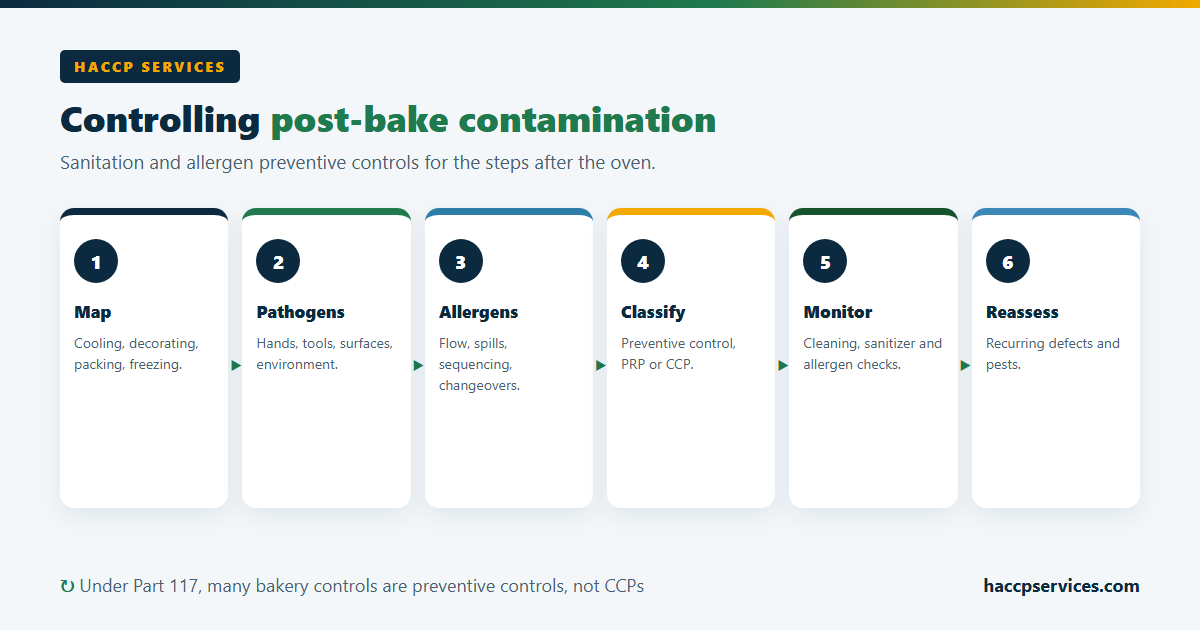
4. Select the right type of control
Distinguish sanitation preventive controls, allergen preventive controls, prerequisite programs and CCPs based on the hazard and the regulatory framework that applies. As a result, each control gets monitoring and records that fit its role. See HACCP critical control points.
5. Set operational monitoring and verification
Specify how cleaning, sanitizer concentration and contact time, allergen changeovers, inspections and deviations are recorded and reviewed. A clean-looking surface with weak sanitizer is not sanitized. See HACCP monitoring procedures.
6. Reassess when findings recur
Evaluate repeated equipment defects such as frayed belts, or recurring pest findings, carry out root cause analysis and revise controls that are not working. See HACCP corrective actions.
Frequently asked questions
Does a written policy alone show control?
No. Procedures must be implemented, monitored and verified.
Do all bakeries need the same sanitation and allergen controls?
No. Controls depend on the hazards, process, ingredients, facility and applicable requirements.
What records help show improvement?
Monitoring logs, training records, maintenance tickets, corrective actions, verification results and management review.
Post-bake contamination checklist
- Confirm the regulatory or certification scope for the facility and products.
- Compare written procedures with direct observation and records.
- Document responsible people, monitoring frequencies and escalation thresholds.
- Review deviations, corrective actions and evidence of effectiveness.
How HACCP Services can help
HACCP Services, a service of Consultare Inc. Group, supports bakery hazard analysis, sanitation and pre-operational inspection programs, preventive maintenance integration and corrective action procedures, subject to the engagement scope and applicable requirements.
- Sanitation program development
- Pre-operational inspection program
- Preventive maintenance integration
- Bakery and confectionery HACCP plans
Need help with your bakery food safety plan?
Discuss your products, processes and documentation with our team. You can book a free consultation or contact our team.
Start building your compliance system
If you prefer to organize and manage your compliance activities yourself, you can also create a free SystemsBuilder account. Then begin building a structured system for your compliance documentation and processes.
Technical sources: 21 CFR Part 117 (CGMP and Preventive Controls for Human Food) and FDA Hazard Analysis Critical Control Point (HACCP). This article is educational; HACCP Services is not affiliated with FDA, and specific requirements depend on your products, processes and applicable regulations.