
Cooling and chilling equipment protects food through temperature control, yet its design can also create contamination routes. Condensate, hard-to-clean coils, drip pans and poorly controlled product movement can all affect exposed food. This article explains why hygienic design should be reviewed alongside temperature control in a HACCP program.
Cold areas are often damp areas. Moisture and low temperatures do not stop every microorganism, and some organisms of concern can survive or grow in cold, wet environments.
Quick answer
Identify where product is exposed in and around cooling equipment. Trace condensate and drip routes, and check that drip pans and drains empty properly. Confirm that coils, fans and pans can be reached for cleaning. Verify temperature devices and records. Finally, control maintenance work so that repairs end with cleaning and inspection before production restarts.
How cooling equipment creates hazards
Several design features deserve attention:
- Condensate. Moisture forming on evaporators, ceilings, pipes and ducts can drip onto product or food-contact surfaces.
- Coils and fans. Fins and fan housings collect dust and moisture and are often hard to reach.
- Drip pans and drain lines. Pans that do not drain fully, or blocked lines, can hold stagnant water.
- Product movement. Racks, carts and conveyors moving through cold rooms can carry contamination between zones.
- Floors and drains. Wet floors and drains in chilled areas may become harborage sites.
As a result, a cooling step can meet its temperature target and still contaminate product. That is why temperature control and hygienic design need separate checks.
What the rules expect
For most FDA-registered facilities, 21 CFR 117.20(b)(4) requires plants to be built so that drip or condensate from fixtures, ducts and pipes does not contaminate food, food-contact surfaces or packaging. In addition, 21 CFR 117.80 says food must be protected from contaminants that may drip, drain or be drawn into it.
Equipment rules apply too. Under 21 CFR 117.40, equipment must be adequately cleanable. Each freezer and cold storage compartment holding food that can support microbial growth must also have a thermometer or temperature-measuring or recording device that shows the temperature accurately. Floor drainage requirements appear in 21 CFR 117.37.
HACCP is mandatory in the U.S. only for juice (21 CFR Part 120), seafood (Part 123) and USDA-inspected meat and poultry (9 CFR Part 417). Elsewhere, HACCP follows the Codex General Principles of Food Hygiene (CXC 1-1969), and most FDA-registered facilities follow Part 117 hazard analysis and risk-based preventive controls.
Hazard analysis or prerequisite program?
Cooling often appears in the hazard analysis as a process step. In many products, time and temperature during cooling control pathogen growth. Our articles on RTE cooling and post-process contamination and HACCP for rice noodles cover that side.
The hygienic design of the equipment, however, usually sits in prerequisite and sanitation programs. Where ready-to-eat food is exposed before packaging, the hazard evaluation under Part 117 must consider environmental pathogens. In that case, cleaning and environmental monitoring around cooling equipment may become central. See our article on Listeria, environmental contamination and sanitation controls.
Practical review steps
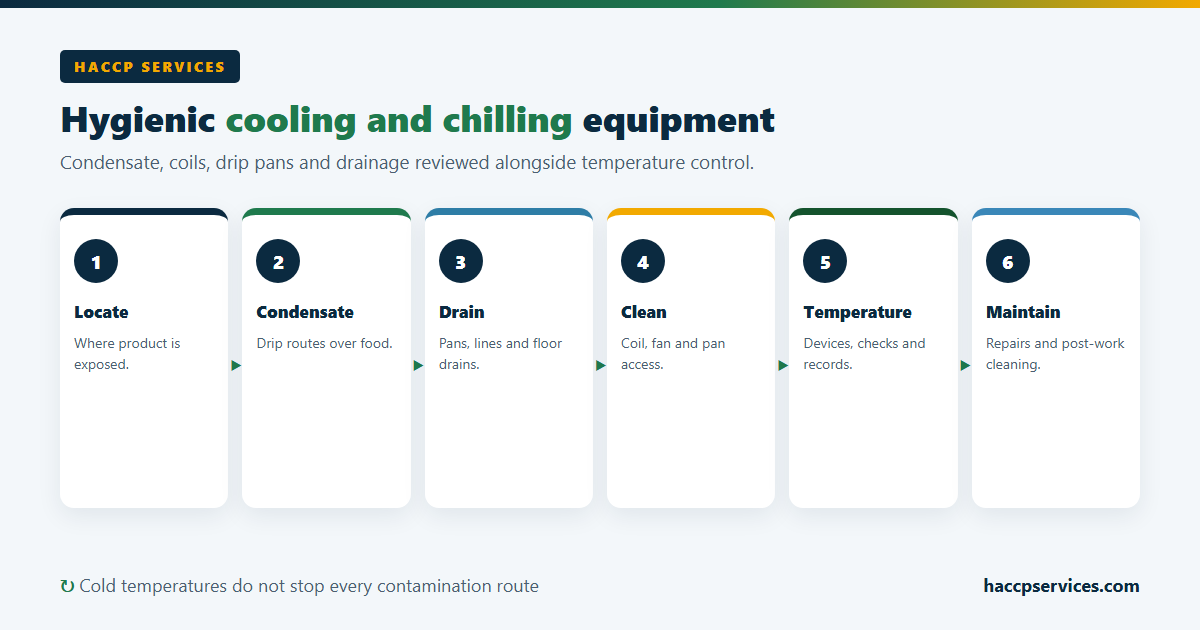
- Locate exposed product. Mark where product, packaging and food-contact surfaces are open in and near cooling equipment.
- Trace condensate. Identify where condensate forms and where it could drip. Look above conveyors, racks and open containers.
- Check drainage. Confirm that drip pans, drain lines and floor drains empty fully and stay clear.
- Confirm cleaning access. Check that coils, fans, housings and pans can be reached, cleaned and inspected.
- Verify temperature control. Confirm that devices are accurate, calibrated and recorded. See our page on HACCP monitoring procedures.
- Control maintenance. Require cleaning and inspection after refrigeration repairs before product is exposed again.
Records to keep
- Temperature monitoring records and device calibration records.
- Cleaning schedules and records for coils, fans, drip pans and drains.
- Condensate observations and the actions taken.
- Environmental monitoring results, where the hazard analysis calls for them.
- Maintenance work orders with post-repair cleaning and release sign-off.
Example scenario
A chilled food plant notices water droplets on product trays leaving a blast chiller. Temperatures are within limits, so the issue is not flagged as a process deviation. However, a supervisor traces the droplets to condensate forming on the evaporator housing above the tray rack.
The team documents the condition and the potential contamination hazard. Then it holds potentially affected product for evaluation. Engineering adjusts the drip pan, and sanitation adds the housing to the cleaning schedule. Finally, the team confirms that no droplets reach product over several shifts and keeps that evidence.
Frequently asked questions
Does meeting the cooling temperature mean the step is safe?
Not on its own. Temperature control and hygienic design are separate issues. Condensate or dirty coils can contaminate product even when temperatures are correct.
Should condensate be treated as a CCP?
Usually not. Condensate is normally managed through facility design and prerequisite programs. The hazard analysis decides whether any control needs to be a preventive control.
What should happen after refrigeration maintenance?
Clean and inspect the area and equipment, and record a release decision before product is exposed again.
Cooling and chilling equipment checklist
- Mark exposed product locations near cooling equipment.
- Trace condensate routes and keep drips away from product.
- Keep drip pans, drain lines and floor drains clear.
- Confirm cleaning access to coils, fans and housings.
- Verify temperature devices and keep records.
- Clean and release equipment after maintenance.
How HACCP Services can help
HACCP Services, a service of Consultare Inc. Group, helps HACCP teams organize cooling-area observations, prerequisite program reviews and targeted action tracking, subject to the engagement scope. Facility management keeps responsibility for approving and implementing changes, and we do not promise certification, regulatory approval or a particular audit outcome.
- Cold storage and distribution HACCP plans
- Environmental monitoring program design
- HACCP sanitation program development
- Calibration and measurement control
Need help reviewing your cooling and chilling equipment?
Discuss your cooling steps, equipment, records and findings with our team. You can book a free consultation or contact our team.
Start building your compliance system
If you prefer to organize and manage your compliance activities yourself, you can also create a free SystemsBuilder account. Then begin building a structured system for your compliance documentation and processes.
Technical sources: 21 CFR 117.20 (plant and grounds), 21 CFR 117.40 (equipment and utensils), 21 CFR 117.80 (processes and controls) and the Codex General Principles of Food Hygiene (CXC 1-1969). This article is educational and is not legal advice; HACCP Services is not affiliated with FDA, and specific requirements depend on your products, processes and applicable regulations.