
Foreign material prevention through equipment design stops fragments at the source, before detection ever has to find them. Loose fasteners, deteriorating belts, damaged guards and unsuitable temporary repairs can all introduce physical hazards into food. Therefore, a strong HACCP program looks at how equipment condition affects the actual process, not just at the detector at the end of the line.
This article explains how equipment creates physical hazards, where those hazards fit in your HACCP system and how to review equipment in a practical way. It is written for HACCP teams, engineering staff and maintenance supervisors.
Quick answer
Equipment design and condition decide how likely parts are to break, loosen or wear into product. So, review wear points, inspection findings, tool control, repair methods and product protection during maintenance. Then assess physical hazards in the hazard analysis and choose controls that fit your operation. Detection may still be a CCP or preventive control, but design and maintenance reduce how often it is needed.
How equipment introduces foreign material
Most equipment-related foreign material comes from a few predictable sources:
- Loose or missing fasteners. Nuts, bolts, washers and screws above or near exposed product can vibrate free.
- Wear parts. Belts, scrapers, seals, gaskets and blades can fray, chip or crack with use.
- Damaged guards and covers. Bent or cracked guards can shed fragments or let debris through.
- Metal-on-metal contact. Misaligned parts can rub and create fine metal particles.
- Temporary repairs. Tape, wire, cable ties and plastic shims can break off into product.
U.S. rules address these sources. Under 21 CFR 117.40(a)(2), equipment must be designed, constructed and used to avoid adulterating food with metal fragments and other contaminants. In addition, 21 CFR 117.80(c)(8) requires adequate measures to protect against metal or other extraneous material in food.
Where foreign material prevention fits in HACCP
HACCP rests on the Codex General Principles of Food Hygiene (CXC 1-1969) and the HACCP principles. In the United States, mandatory HACCP applies to juice (21 CFR Part 120), seafood (Part 123) and USDA-inspected meat and poultry (9 CFR Part 417). Most other FDA-registered facilities follow 21 CFR Part 117. There, 21 CFR 117.130 requires the hazard analysis to consider physical hazards, such as stones, glass and metal fragments.
In practice, equipment design and maintenance usually work as prerequisite programs. Meanwhile, the HACCP hazard analysis decides whether a physical hazard is significant enough to need a specific control. If it is, a step such as metal detection or X-ray may become a critical control point or preventive control. For a program-level view, see our article on foreign material prevention and HACCP controls.
Design features that help prevent foreign material
- Captive or retained fasteners where parts sit above exposed product.
- Materials suited to the product, temperature and cleaning chemicals.
- Guards and covers that are robust and easy to inspect.
- Equipment layout that keeps overhead parts away from open product where possible.
- Access for inspection, so wear is spotted before parts fail.
A practical equipment review
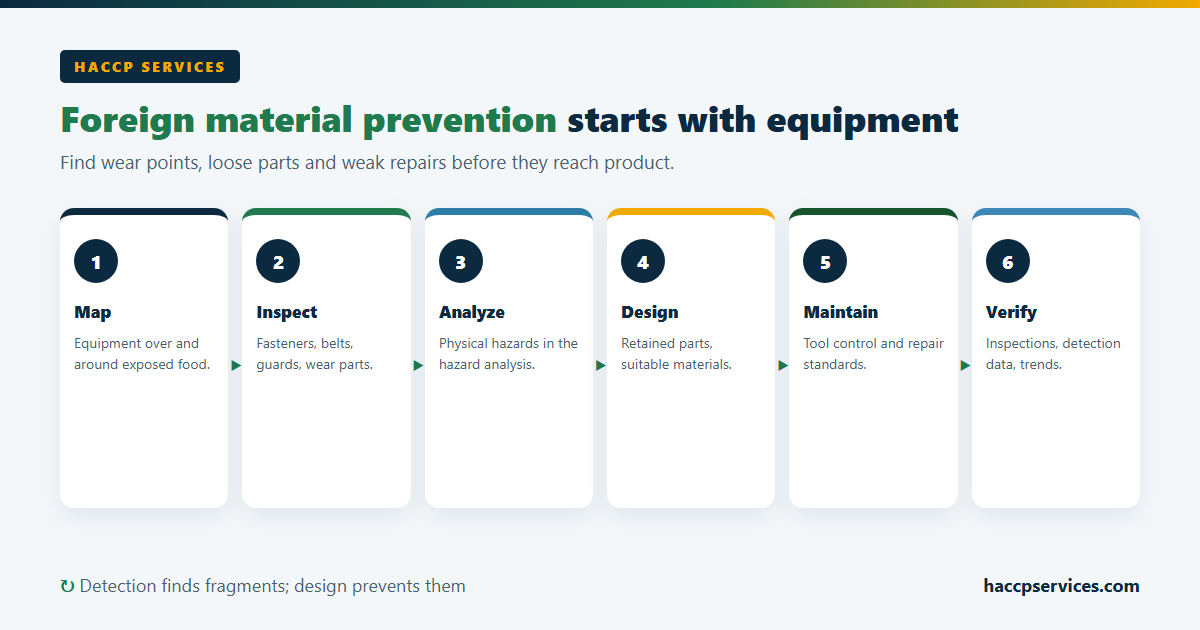
1. Map and inspect
First, list equipment over and around exposed food. Then inspect fasteners, belts, guards, blades and other wear parts. Record what you find, with photos and locations.
2. Analyze the hazard
Next, assess each finding for severity and likelihood. Consider the product, the size and type of possible fragments and any downstream detection. Our bakery hazard analysis shows how worn metal parts feed into this assessment.
3. Improve design and maintenance
Then choose proportionate fixes. These may include replacing parts with retained designs, changing materials or adding inspection points. Strengthen tool control, repair standards and product protection during maintenance as well.
4. Verify
Finally, confirm the change works. Review inspection results, detector rejects and complaint trends. If the same fragments keep appearing, revisit the root cause.
Records to keep
- An equipment inventory with wear parts and inspection points.
- Pre-operational and periodic equipment inspection records.
- Maintenance work orders and post-repair release checks.
- Detector reject logs and investigations, where detection is used.
- Corrective action records with root cause and effectiveness review.
Example scenario
Consider a hypothetical frozen vegetable packer. The metal detector rejects several packs with small fragments over two weeks. An investigation traces them to a worn scraper blade on a hopper.
The team holds affected product and evaluates it. Next, they replace the blade and add it to the weekly inspection list. They also review the hopper design and fit a retained fastener on the blade mount. Finally, they track detector rejects for the next month to confirm the fix. The hazard analysis now records the scraper as a known wear point, with inspection as a supporting prerequisite control.
Frequently asked questions
Is metal detection enough to control foreign material?
Not on its own. Detection finds some fragments, but design, inspection and maintenance prevent them in the first place.
Should every wear part be a critical control point?
No. Wear parts are usually managed through prerequisite programs. The hazard analysis decides whether a specific CCP or preventive control is needed.
What should happen after a part is found missing?
Hold potentially affected product, search for the part, evaluate the product and document the corrective action and root cause.
Foreign material prevention checklist
- List equipment above and around exposed product.
- Inspect fasteners, belts, guards and other wear points on a set schedule.
- Assess physical hazards in the hazard analysis.
- Apply foreign material prevention through equipment design, such as retained parts and suitable materials.
- Control tools, parts and temporary repairs during maintenance.
- Verify with inspection results, reject data and trends.
How HACCP Services can help
HACCP Services, a service of Consultare Inc. Group, helps HACCP teams with equipment risk reviews, preventive maintenance records and corrective action tracking, subject to the engagement scope. Facility management approves and carries out changes, and we do not promise certification, regulatory approval or a particular audit outcome.
- Foreign material control program development
- Preventive maintenance and food safety integration
- Deviation investigation and root cause analysis
- Corrective action management
Need help preventing foreign material?
Discuss your equipment, inspection records and risks with our team. You can book a free consultation or contact our team.
Start building your compliance system
If you prefer to organize and manage your compliance activities yourself, you can also create a free SystemsBuilder account. Then begin building a structured system for your compliance documentation and processes.
Technical sources: Codex Alimentarius General Principles of Food Hygiene (CXC 1-1969), 21 CFR 117.40 (equipment and utensils), 21 CFR 117.80 (processes and controls) and 21 CFR 117.130 (hazard analysis). This article is educational and is not legal advice; HACCP Services is not affiliated with FDA, and specific requirements depend on your products, processes and applicable regulations.