
Hygienic design for ingredient transfer systems matters because pumps, pipes, hoses and connections hide most of their food-contact surfaces. When the arrangement does not suit the product or the cleaning process, these parts can hold residues or allow allergen cross-contact. This article explains how transfer design creates hazards and how to review it in a HACCP program.
Hidden surfaces need special attention. Because nobody sees inside a pipe during production, problems often show up only as a positive swab, an off-odor or a customer complaint.
Quick answer
Trace every transfer route from source to destination. Look for dead legs, poor drainage and hard-to-clean connections. Then confirm that clean-in-place (CIP) or manual cleaning actually reaches each surface. Label lines and connections clearly, and control changeovers between products and allergens. Finally, record the resulting hazards and controls in your hazard analysis.
How transfer systems create hazards
Ingredient transfer systems move liquids, slurries and powders between tanks, mixers and fillers. Several design features can turn them into contamination sources:
- Dead legs. Branches where product sits still can escape cleaning flow and support microbial growth.
- Poor drainability. Low points and flat runs can pool water or product after cleaning.
- Connections and gaskets. Threads, worn gaskets and unsuitable connection materials can trap residues.
- Flexible hoses. Hoses are easy to move between lines, which makes cross-contact more likely if they are not dedicated or cleaned between uses.
- Unclear identification. Unlabeled lines and swing panels make wrong connections more likely.
As a result, the same system can create biological hazards from residue build-up, chemical hazards from cleaning solution carry-over, and allergen cross-contact from shared routes.
What the rules expect
For most FDA-registered facilities, 21 CFR 117.40(d) states that holding, conveying and manufacturing systems, including pneumatic, closed and automated systems, must be designed and built so they can be kept clean and sanitary. In addition, seams on food-contact surfaces must be smoothly bonded or maintained to minimize accumulation of food particles.
The hazard analysis under 21 CFR 117.130 must also consider the condition, function and design of facility equipment. Where a hazard needs a preventive control, sanitation controls under 21 CFR 117.135(c)(3) cover the cleanliness of food-contact surfaces and the prevention of allergen cross-contact. HACCP itself is mandatory in the U.S. only for juice (21 CFR Part 120), seafood (Part 123) and USDA-inspected meat and poultry (9 CFR Part 417). Elsewhere, HACCP follows the Codex General Principles of Food Hygiene (CXC 1-1969).
Hazard analysis or prerequisite program?
Routine cleaning and line maintenance usually sit in prerequisite programs, as our HACCP prerequisite checklist explains. However, some transfer risks deserve explicit treatment in the hazard analysis. A shared line that moves allergen-containing and allergen-free products is a common example. In that case, changeover cleaning and line clearance may become a preventive control rather than a background program.
Start with an accurate drawing. Our article on process flow diagram verification explains why the flow diagram must match the real plant, including transfer routes. Then evaluate hazards step by step, as described in our HACCP hazard analysis guide.
Practical review steps
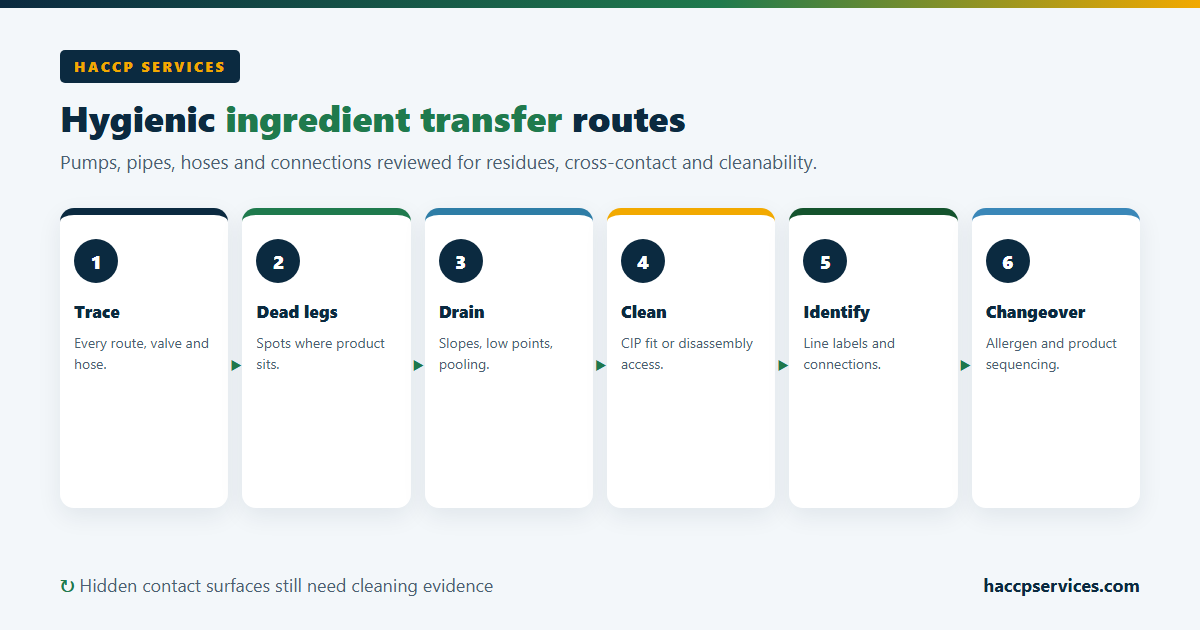
- Trace every route. Walk each line from source to destination. Include valves, hoses, swing panels and temporary connections.
- Find dead legs. Mark branches and fittings where product or cleaning solution may sit still.
- Check drainability. Look for low points, sags and flat runs that hold liquid after cleaning.
- Confirm cleaning reach. Decide whether CIP suits each section. Where it does not, confirm that disassembly and manual cleaning are practical.
- Identify lines. Label lines, hoses and connection points so operators make the right connection.
- Control changeovers. Set product sequencing, flushing and cleaning steps, especially for allergen changeovers.
Records to keep
- Current line drawings or route maps, reviewed against the plant.
- CIP and manual cleaning procedures for each section, with key parameters.
- Changeover and line clearance records, including allergen changeovers.
- Inspection, swab and verification results for hidden surfaces.
- Repairs, modifications and corrective actions, with closure evidence.
Example scenario
A sauce plant adds a new branch line to feed a second filler. Months later, routine swabs near the filler start to fail. The team traces the route and finds that the old branch, now capped, forms a dead leg. Cleaning solution never flows through it.
The team documents the condition and the potential microbial hazard. Then it ranks severity and likelihood, assigns an owner and sets a deadline. Engineering removes the unused branch, and sanitation updates the CIP procedure. Finally, the team confirms the fix with follow-up swabs and updates the flow diagram.
Frequently asked questions
Does CIP remove the need for disassembly?
Not always. CIP works only where the flow reaches each surface. Valves, gaskets and some fittings may still need periodic disassembly and inspection.
Are transfer system controls CCPs?
Usually not. Most are prerequisite or sanitation controls. The hazard analysis decides whether a specific control needs to be a preventive control or a CCP.
When should we review transfer routes again?
Review them after line changes, new products or allergens, repeat swab failures, and as part of reanalysis.
Ingredient transfer systems hygienic design checklist
- Map every route, valve, hose and connection.
- Remove or manage dead legs and low points.
- Confirm CIP reach or practical disassembly for each section.
- Label lines and control temporary connections.
- Control allergen and product changeovers.
- Record related hazards in the hazard analysis and keep cleaning evidence.
How HACCP Services can help
HACCP Services, a service of Consultare Inc. Group, helps HACCP teams review transfer-system prerequisite controls, document sanitation gaps and coordinate risk-based improvements, subject to the engagement scope. Facility management keeps responsibility for approving and implementing changes, and we do not promise certification, regulatory approval or a particular audit outcome.
- HACCP sanitation program development
- Allergen management program development
- Cross-contamination and hygienic zoning assessment
- Prerequisite program gap assessment
Need help reviewing your ingredient transfer systems?
Discuss your lines, cleaning methods, changeovers and records with our team. You can book a free consultation or contact our team.
Start building your compliance system
If you prefer to organize and manage your compliance activities yourself, you can also create a free SystemsBuilder account. Then begin building a structured system for your compliance documentation and processes.
Technical sources: 21 CFR 117.40 (equipment and utensils), 21 CFR 117.130 (hazard analysis), 21 CFR 117.135 (preventive controls) and the Codex General Principles of Food Hygiene (CXC 1-1969). This article is educational and is not legal advice; HACCP Services is not affiliated with FDA, and specific requirements depend on your products, processes and applicable regulations.