
HACCP equipment maintenance protects food safety only when repairs are coordinated with food safety controls. Otherwise, a routine job can introduce foreign material, lubricant, debris or microbiological hazards. For example, a forgotten tool, a cut cable tie or a wrench left on a frame can end up in product.
This article explains how maintenance creates hazards, where it fits in your HACCP system and which practical controls make repairs safe. It is written for HACCP managers, plant maintenance leaders and sanitation supervisors.
Quick answer
Good HACCP equipment maintenance plans each job around product protection. That means controlling tools and spare parts, using suitable lubricants, restricting temporary repairs and cleaning or inspecting equipment before it returns to production. These practices are usually prerequisite programs. Even so, your hazard analysis should consider them, and records should show they happen.
How maintenance work creates hazards
Maintenance is essential, yet it opens equipment and brings people, tools and materials into production areas. As a result, several hazards can appear:
- Physical hazards. Loose fasteners, swarf, wire, broken parts or tools can fall into product or onto food-contact surfaces.
- Chemical hazards. Lubricants, solvents or sealants can contact product if they are unsuitable or over-applied.
- Biological hazards. Opened equipment, dirty tools and disturbed residue can spread microorganisms to clean surfaces.
- Allergen cross-contact. Tools and parts moved between lines can carry allergenic residue.
U.S. rules reflect these risks. Under 21 CFR 117.40(a), equipment must be adequately maintained and must be designed, constructed and used to avoid adulterating food with lubricants, fuel, metal fragments or other contaminants. In addition, 21 CFR 117.80(c)(1) requires equipment to be maintained in adequate condition through cleaning and sanitizing as necessary.
Where maintenance fits in HACCP
HACCP builds on the Codex General Principles of Food Hygiene (CXC 1-1969), where maintenance is part of the hygiene foundation. In the United States, mandatory HACCP applies to juice (21 CFR Part 120), seafood (Part 123) and USDA-inspected meat and poultry (9 CFR Part 417). Most other FDA-registered facilities follow 21 CFR Part 117, where a written hazard analysis may lead to preventive controls.
In either case, maintenance controls usually sit in prerequisite programs. However, your HACCP hazard analysis should still record equipment condition as an input. Where a hazard such as metal is significant, the plan may rely on a CCP or preventive control, like metal detection. Even then, good maintenance reduces how often that control has to catch a problem. Our article on foreign material prevention and HACCP controls explores that relationship.
Key review considerations
- Identify where food, residues, moisture or allergens could accumulate on and around equipment.
- Check whether routine cleaning and inspection can reach the surfaces that maintenance disturbs.
- Evaluate layout, personnel movement, utilities and maintenance interfaces.
- Review records of sanitation failures, equipment repairs and recurring observations.
- Separate applicable requirements from voluntary technical guidance.
Practical HACCP equipment maintenance controls
Define the following controls based on risk, then train both maintenance and production staff on them.
1. Plan the job and protect product
Before work starts, decide whether product must be removed or covered. Also decide whether the line must stop. Planned work is safer than rushed work during production.
2. Control tools and spare parts
Count tools in and out of the area. In addition, keep spare parts clean and stored away from contamination. Account for removed fasteners and small parts before release.
3. Use appropriate lubricants
Choose lubricants suited to the location. Where incidental food contact is possible, use products intended for that use. Apply only the amount needed and remove the excess.
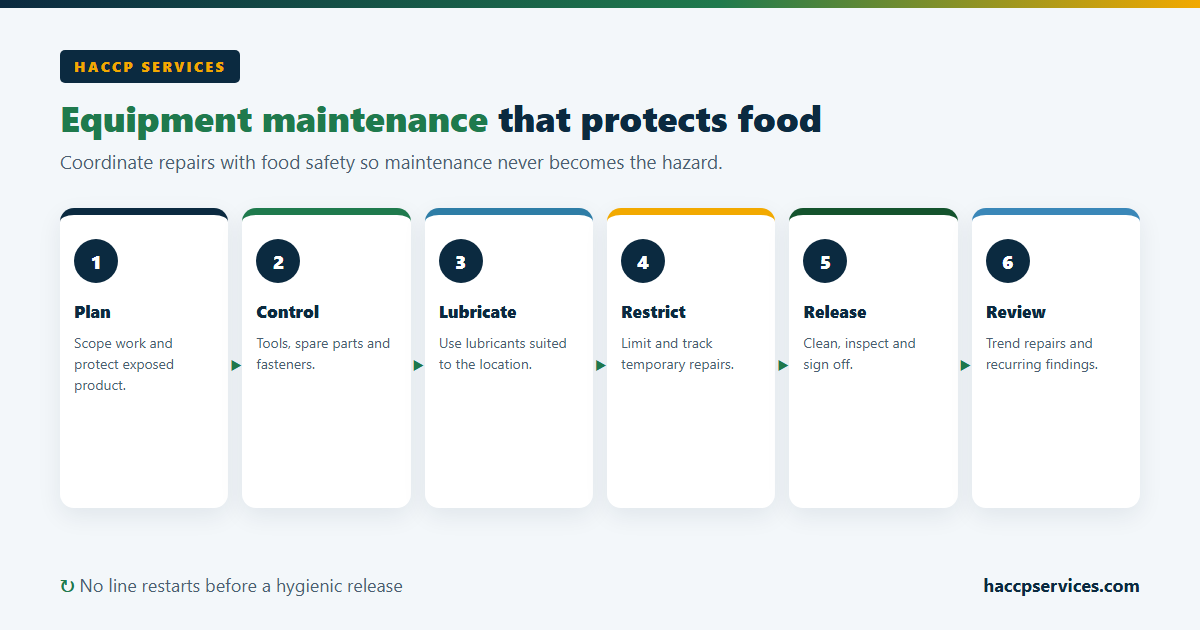
4. Restrict temporary repairs
Tape, wire, cable ties and cardboard can become foreign material. So, limit temporary repairs, label them, give them a removal date and track them to closure.
5. Release equipment hygienically
After maintenance, clean and inspect the equipment as the risk requires. Then have a trained person sign off before production restarts. A pre-operational inspection program can build this check into routine start-up.
6. Review and improve
Finally, trend repairs, findings and recurring failures. Repeated breakdowns often point to a design or preventive maintenance gap.
Records to keep
- Work orders that note food safety precautions and the area affected.
- Tool and parts reconciliation for work in production areas.
- Hygienic release or post-maintenance inspection sign-offs.
- A temporary repair log with removal dates.
- Preventive maintenance schedules and completion records.
- Corrective actions linked to maintenance-related findings. See our guide to HACCP monitoring records and verification review.
Example scenario
Consider a hypothetical snack plant. A bearing on a seasoning drum fails mid-shift, so a mechanic replaces it on the spot. Afterwards, production restarts without a check. Later, a sanitation worker finds a missing washer and a smear of grease near the drum outlet.
The team places affected product on hold and evaluates it. Next, they investigate the root cause and find no defined release step for unplanned repairs. As a fix, they add a short hygienic release checklist, a tool and parts count and a post-repair clean. They also train mechanics and line leads. Finally, the team verifies the change by reviewing release records over the following weeks.
Frequently asked questions
Are maintenance controls part of the HACCP plan?
Usually, they are prerequisite programs. The hazard analysis should still consider equipment condition, and records should show the controls work.
What is a hygienic release after maintenance?
It is a documented check that equipment is clean, complete and free of tools and debris before production resumes.
Can metal detection replace good maintenance?
No. Detection catches some fragments, but prevention through maintenance reduces how often contamination occurs in the first place.
HACCP equipment maintenance checklist
- Plan jobs and protect exposed product before work starts.
- Count tools and account for parts and fasteners.
- Use lubricants suited to the location and possible food contact.
- Label, limit and track temporary repairs.
- Clean, inspect and sign off equipment before restart.
- Trend HACCP equipment maintenance findings and repeat failures.
How HACCP Services can help
HACCP Services, a service of Consultare Inc. Group, helps HACCP teams strengthen maintenance-related prerequisite programs, clarify records and improve corrective action tracking across departments, subject to the engagement scope. Facility management approves and carries out changes, and we do not promise certification, regulatory approval or a particular audit outcome.
- Preventive maintenance and food safety integration
- Pre-operational inspection program development
- Foreign material control program development
- Corrective action management
Need help with HACCP equipment maintenance?
Discuss your equipment, maintenance practices, records and risks with our team. You can book a free consultation or contact our team.
Start building your compliance system
If you prefer to organize and manage your compliance activities yourself, you can also create a free SystemsBuilder account. Then begin building a structured system for your compliance documentation and processes.
Technical sources: Codex Alimentarius General Principles of Food Hygiene (CXC 1-1969), 21 CFR 117.35 (sanitary operations), 21 CFR 117.40 (equipment and utensils) and 21 CFR 117.80 (processes and controls). This article is educational and is not legal advice; HACCP Services is not affiliated with FDA, and specific requirements depend on your products, processes and applicable regulations.