
Manufacturing site changes, such as new equipment, moved production or outsourced steps, need two separate reviews. HACCP personnel assess the food safety effects of the change. Registration implications, however, call for a separate regulatory review. Mixing the two can leave one of them undone.
This article explains how to run both reviews when a process or site changes, and how they connect to the 2026 biennial renewal. It is part of our FDA registration renewal 2026 series.
Quick answer: Log the change, reassess hazards through your HACCP or food safety plan procedures, and separately check whether FDA registration details changed. Then decide whether a new registration, an update or simply the renewal is needed. Covered facilities still renew by December 31, 2026.
Who this article is for
This guide is written for plant managers, HACCP coordinators, PCQIs, engineering and project teams, and regulatory contacts who manage capital projects, line transfers or outsourcing decisions.
1. Recognize the changes that need review
Not every change affects both tracks. Still, many common projects do. Typical examples include:
- Adding processing equipment or a new line.
- Moving a product from one plant to another.
- Opening, closing or acquiring a building.
- Outsourcing a step, such as packing or cold storage, to another company.
- Changing the operator, agent in charge or legal entity of a site.
Our article on facility changes that may trigger FDA registration review lists ownership and entity events in more detail. Here, the focus is on process and manufacturing changes that start on the plant floor.
2. Assess HACCP impacts through technical procedures
First, update the process flow diagram and walk the new flow. Then review the hazard analysis for new or changed steps. Our guide to process flow diagram verification explains how to confirm the diagram matches reality.
The rules set clear expectations here. Under 21 CFR 117.170, a Part 117 facility must reanalyze its food safety plan when a significant change creates a reasonable potential for a new hazard or a significant increase in an existing one. That reanalysis must be done before the change is operative, or within the timeframes the rule allows. Seafood processors must reassess their HACCP plan whenever changes could affect the hazard analysis, under 21 CFR 123.8.
3. Independently assess the registration track
Next, a regulatory contact looks at the same change from FDA’s point of view. The questions are different:
- Is there a new facility? Under 21 CFR 1.230, a facility that must register does so before it begins to manufacture, process, pack or hold food.
- Did required information change? Under 21 CFR 1.234, covered facilities update registration within 60 calendar days of a change to required information, such as activity types or product categories.
- Did the owner change? If so, the former owner cancels the registration and the new owner submits a new one.
The answers depend on the actual facts. Applicability and exemptions must be assessed for each facility.
4. Remember that an update is not a renewal
Facilities required to register must renew between October 1 and December 31 of each even-numbered year. The 2026 deadline is December 31, 2026. FDA states that updating a registration is a different function from renewing it. As a result, a mid-year update made after a site change does not replace the 2026 renewal. FDA charges no renewal fee and currently accepts the DUNS number as the Unique Facility Identifier.
5. Handle outsourcing with care
When you move a step to another company, the hazards do not disappear. Instead, they move to a site you do not operate. Your HACCP team should decide how that supplier’s controls are verified. Meanwhile, the other company remains responsible for its own facility registration, where applicable. Our article on contract food manufacturing covers that split.
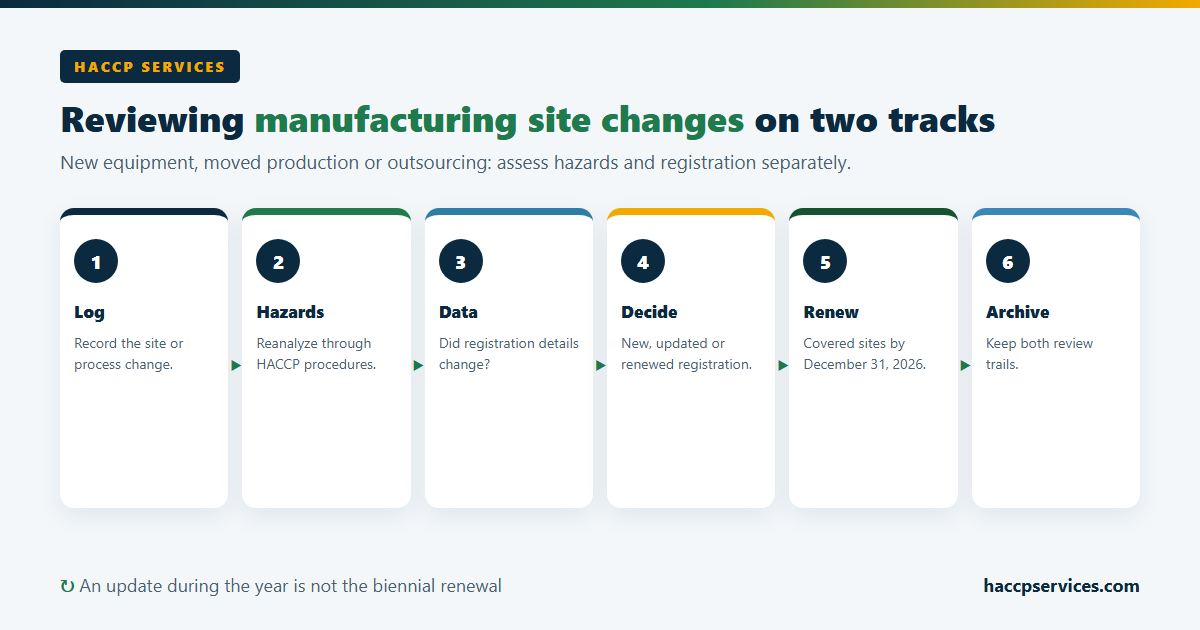
Example change review workflow
- The project owner opens a change request that names the site, process and products affected.
- The HACCP team or PCQI updates the flow diagram and completes the hazard reanalysis.
- The regulatory contact reviews registration information and applicability for each affected site.
- Management approves the change only when both reviews are closed.
- The regulatory contact confirms the 2026 renewal for covered sites.
- Both teams archive their evidence under the same change number.
Common mistakes to avoid
- Starting production on a new line before the hazard reanalysis is complete.
- Assuming the HACCP change review also covered registration.
- Forgetting product category or activity changes in the registration.
- Treating a mid-year update as the biennial renewal.
Frequently asked questions
Does a HACCP reanalysis cover the registration review?
No. The reanalysis addresses hazards. Registration information and applicability need a separate regulatory review.
When must a Part 117 food safety plan be reanalyzed after a change?
When a significant change creates a reasonable potential for a new hazard or a significant increase in a known hazard, under 21 CFR 117.170.
If we updated our registration after the change, do we still renew?
Yes, if the facility must register. An update does not replace the biennial renewal.
Manufacturing site changes checklist
- Document the change in site or operations.
- Update the process flow diagram and reassess hazards.
- Independently assess registration information and applicability.
- Submit any required update through an authorized person.
- Verify the 2026 renewal for covered facilities.
- Archive both review trails under one change reference.
How HACCP Services can help
HACCP Services, a service of Consultare Inc. Group, supports HACCP plan updates, process change assessments, hazard analysis and regulatory record coordination, subject to the engagement scope.
- New product and process change impact assessment
- Food safety change management
- HACCP plan reassessment
- HACCP regulatory compliance audits
Need help reviewing a site or process change?
Discuss the food safety and regulatory compliance support your operations need with our team. You can book a free consultation or contact our team.
Start building your compliance system
If you prefer to organize and manage your compliance activities yourself, you can also create a free SystemsBuilder account. Then begin building a structured system for your compliance documentation and processes.
Technical sources: FDA Food Facility Registration User Guide: Biennial Registration Renewal, FDA reminder on biennial renewal requirements, FDA Online Registration of Food Facilities, 21 U.S.C. 350d, 21 CFR Part 1, Subpart H and 21 CFR Part 117. This article is educational and is not legal advice; HACCP Services is not affiliated with FDA, and specific requirements depend on your facility, operations and applicable regulations. Verify current requirements through official FDA sources.