
A HACCP plan does not replace FDA registration, and FDA registration does not replace a HACCP plan. A HACCP plan addresses significant food safety hazards in a process. FDA food facility registration, by contrast, identifies certain establishments in the regulated food supply chain. Each one answers a different question, so neither can stand in for the other.
This distinction matters most during the 2026 biennial renewal period. Teams with strong food safety programs sometimes assume their technical documents cover every regulatory duty. This article explains why the two obligations stay separate and how to manage both without gaps. It belongs to our FDA registration renewal 2026 series.
Quick answer: If your facility must register with FDA, renew between October 1 and December 31, 2026. Your HACCP plan or Part 117 food safety plan does not count as that renewal. Likewise, a renewal confirmation does not validate your hazard analysis or approve your products.
Who this article is for
This guide is written for food safety managers, HACCP coordinators, preventive controls qualified individuals (PCQIs), quality teams and regulatory contacts at food manufacturing, packing and holding facilities.
1. What a HACCP plan or food safety plan does
A HACCP plan is a technical document. It follows the principles in the Codex General Principles of Food Hygiene (CXC 1-1969) and the NACMCF guidance. Your team analyzes hazards, identifies critical control points, sets critical limits and defines monitoring, corrective actions, verification and records.
Mandatory FDA HACCP applies to juice (21 CFR Part 120) and seafood (21 CFR Part 123). USDA FSIS requires HACCP for meat and poultry under 9 CFR Part 417. However, most FDA-registered food facilities fall under 21 CFR Part 117 instead. Under 21 CFR 117.126, those facilities must prepare and implement a written food safety plan. A PCQI must prepare it or oversee its preparation. For a side-by-side view, see HACCP plan vs FDA food safety plan.
In short, both plan types deal with hazards and controls. Neither one tells FDA that your facility exists, where it is or what it does.
2. What FDA facility registration does
Registration rests on section 415 of the Federal Food, Drug, and Cosmetic Act (21 U.S.C. 350d) and 21 CFR Part 1, Subpart H. Under 21 CFR 1.225, owners, operators or agents in charge of facilities that manufacture/process, pack or hold food for U.S. consumption must register, unless an exemption in 21 CFR 1.226 applies. Exemptions include farms, retail food establishments and restaurants, among others.
The registration itself holds administrative information. It includes the facility name and address, a Unique Facility Identifier, food product categories and activity types. It also includes an assurance that FDA may inspect the facility. Registration is not FDA approval of the facility, its products or its food safety program.
3. Why one cannot substitute for the other
The two tracks have different triggers, owners and evidence. For example, a validated HACCP plan says nothing about whether your facility renewed its registration. In the same way, a renewal confirmation says nothing about whether your critical limits are scientifically sound.
- Trigger: Registration applicability depends on the activities, location and exemptions. Plan requirements depend on the product, the process and the applicable rule.
- Owner: The owner, operator or agent in charge, or an authorized individual, submits registration. The HACCP team or PCQI owns the technical plan.
- Evidence: Registration produces a confirmation. A plan produces monitoring, corrective action and verification records.
Our article on FDA facility registration versus HACCP responsibilities covers who does what on each track. Here, the focus is on the plans themselves.
4. Know the 2026 renewal facts
Under 21 CFR 1.230, facilities that must register renew between October 1 and December 31 of each even-numbered year. The 2026 deadline is December 31, 2026. FDA states that updating a registration is a different function from renewing it. Therefore, an update earlier in the year does not count as the renewal.
FDA currently recognizes the DUNS number as an acceptable Unique Facility Identifier. In addition, FDA charges no fee for registration or renewal. Applicability and exemptions still depend on each facility’s circumstances.
5. A practical workflow for both tracks
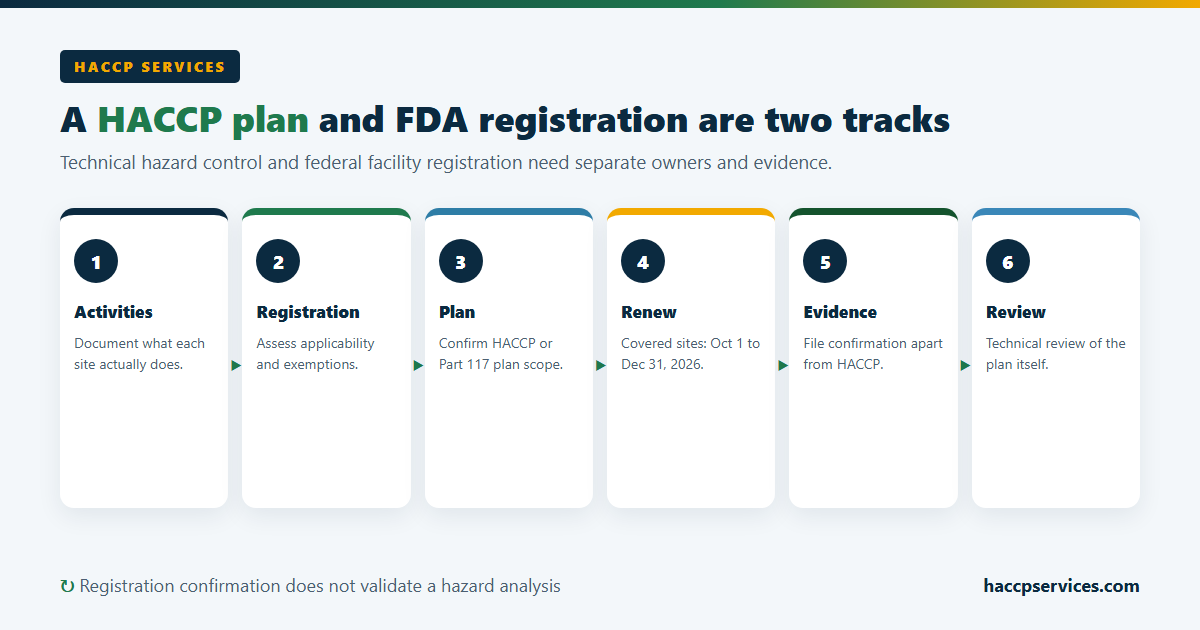
A simple, repeatable workflow keeps the two obligations visible:
- Document the operating activities at each site, such as manufacturing, packing or holding.
- Have the regulatory contact assess registration applicability and exemptions for each site.
- Separately, have the HACCP team or PCQI confirm the scope of the HACCP plan or food safety plan.
- For covered sites, confirm the 2026 renewal was submitted and accepted.
- File the renewal confirmation in a regulatory file, apart from HACCP records.
- Review the plan on its technical merits, including hazard analysis, validation and verification.
6. Common mistakes to avoid
- Treating a certificate or audit as registration. A third-party audit or HACCP certificate is not FDA registration. “HACCP certification” is not a single legal certificate issued by FDA.
- Treating registration as validation. A registration number does not show that hazards are controlled.
- Assuming the plant covers every site. Each facility’s registration status needs its own assessment.
- Confusing an update with a renewal. An earlier 2026 update does not satisfy the biennial renewal.
Records to keep
On the regulatory side, keep the registration number, renewal confirmation, the DUNS record used and the name of the person who submitted. On the technical side, keep the hazard analysis, the plan and the implementation records. Under 21 CFR 117.190, Part 117 facilities must keep monitoring, corrective action and verification records. Strong HACCP document control helps keep both sets current without mixing them.
Frequently asked questions
Does having a HACCP plan mean my facility is registered with FDA?
No. A HACCP plan is a technical food safety document. Registration is a separate submission to FDA for facilities that are required to register.
Does FDA registration approve my HACCP plan or products?
No. Registration identifies the facility. It does not validate a hazard analysis or approve any product.
Who should prepare a Part 117 food safety plan?
Under 21 CFR 117.126, a preventive controls qualified individual must prepare the plan or oversee its preparation.
Does an update earlier in 2026 replace the renewal?
No. FDA treats an update and a renewal as different functions, so covered facilities still need to renew by December 31, 2026.
HACCP plan and registration checklist
- Document the operating activities at each facility.
- Review registration applicability separately from HACCP scope.
- Confirm the 2026 renewal for covered facilities.
- Retain renewal confirmation in a regulatory file.
- Maintain independent technical review of HACCP or food safety plan documents.
- Assign named owners for each track.
How HACCP Services can help
HACCP Services, a service of Consultare Inc. Group, supports HACCP plan development, hazard analysis, process verification and food safety documentation, subject to the engagement scope.
- HACCP plan development
- Hazard analysis support
- HACCP plan validation
- HACCP regulatory compliance audits
Need help keeping your plan and registration on track?
Discuss your regulatory documentation, compliance coordination and food safety management needs with our team. You can book a free consultation or contact our team.
Start building your compliance system
If you prefer to organize and manage your compliance activities yourself, you can also create a free SystemsBuilder account. Then begin building a structured system for your compliance documentation and processes.
Technical sources: FDA Food Facility Registration User Guide: Biennial Registration Renewal, FDA reminder on biennial renewal requirements, FDA Online Registration of Food Facilities, 21 U.S.C. 350d, 21 CFR Part 1, Subpart H and 21 CFR Part 117. This article is educational and is not legal advice; HACCP Services is not affiliated with FDA, and specific requirements depend on your facility, operations and applicable regulations. Verify current requirements through official FDA sources.