
HACCP plans for Walmart food suppliers start with the product and the process, not the retailer name. A sound hazard analysis connects product safety, staff execution and audit evidence. Whether HACCP is a legal requirement for your product depends on the product category and the regulatory framework that applies.
For businesses preparing to supply Walmart, sound regulatory programs and credible records support supplier confidence and operational readiness. However, retailer-specific obligations depend on the program, product category and commercial arrangements. Confirm them directly with the relevant Walmart contact.
Quick answer
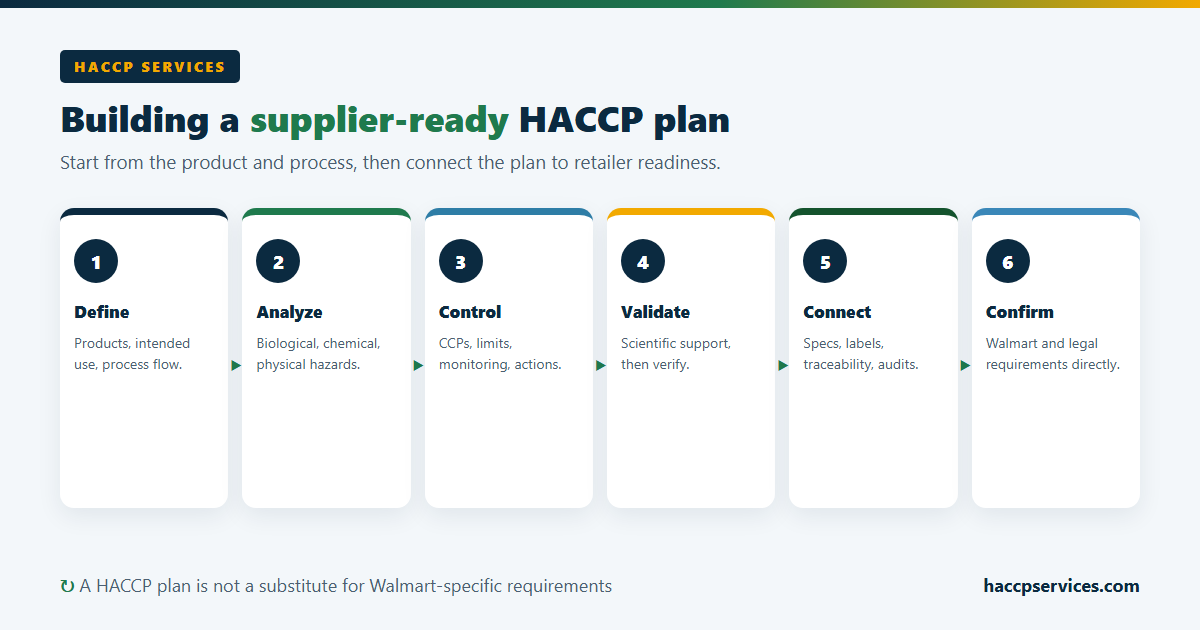
Build the plan around your own products and process flow. Then assess biological, chemical and physical hazards, set controls and monitoring, and validate and verify the plan. Finally, connect it to specifications, labeling, traceability and audit evidence. A HACCP plan on its own does not replace certification or any Walmart-specific supplier requirement.
Who this article is for
This guide is for food manufacturers, HACCP teams and quality leaders preparing documentation for large retail customers such as Walmart.
1. Know which framework applies
HACCP principles come from the Codex General Principles of Food Hygiene (CXC 1-1969) and its HACCP annex. In the United States, mandatory HACCP plans apply to juice (21 CFR Part 120), seafood (21 CFR Part 123) and USDA FSIS-regulated meat and poultry (9 CFR Part 417). Most other FDA-registered food facilities fall under 21 CFR Part 117, which requires a food safety plan prepared or overseen by a preventive controls qualified individual (21 CFR 117.126). Also, “HACCP certification” is not a single legal certificate; it usually refers to a third-party audit or scheme. See our HACCP plan vs FDA food safety plan guide for the differences.
2. Define products, intended use and process flow
List ingredients, product characteristics, intended users, distribution conditions and manufacturing steps. Then verify the flow diagram against actual plant operations. Account for rework, shared lines, receiving, storage, packaging and outsourced steps, because each can affect the hazard analysis. Our guide to process flow diagram verification explains the method.
3. Assess biological, chemical and physical hazards
Evaluate reasonably likely hazards at each step. Base the review on ingredients, equipment, people, environment and the intended consumer. Clearly separate a hazard that needs a control from a general sanitation or quality concern. In addition, document the rationale behind each decision. See HACCP hazard analysis for the principle.
4. Establish controls and monitoring
Where applicable, define critical control points, critical limits, monitoring methods, frequency, responsibility, deviations and corrective actions. For facilities covered by the FDA preventive controls rule, assess whether the food safety plan needs preventive controls beyond a traditional HACCP approach. Our page on HACCP critical control points covers how CCPs are chosen.
5. Validate and verify the plan
Support each control with appropriate scientific or technical evidence. Next, verify that procedures work as intended through reviews, observations, testing or calibration. Retain dated records and identify approvers. Review the plan when products, equipment, formulations or regulatory expectations change.
6. Connect the food safety plan to supplier readiness
Make sure the documented plan aligns with product specifications, labeling, traceability, supplier approval and audit evidence. A HACCP plan is not, by itself, a substitute for certification or every Walmart-specific supplier requirement. Therefore, confirm actual applicability with Walmart. Walmart publishes general information on its supplier requirements page.
Frequently asked questions
Does Walmart require a HACCP plan?
Requirements depend on the program, product category and commercial arrangement. Confirm current requirements directly with the relevant Walmart contact.
Does a strong HACCP plan guarantee acceptance as a Walmart supplier?
No. A sound plan and credible records support readiness, but supplier approval rests with Walmart and its own requirements.
Is “HACCP certification” a legal certificate?
No. It is not a single legal certificate. It usually refers to a third-party audit, while legal duties come from the regulation that applies to your product.
Supplier readiness checklist
- Define products, intended use and process flow.
- Assess biological, chemical and physical hazards.
- Establish controls and monitoring.
- Validate and verify the plan.
- Connect the food safety plan to supplier readiness.
- Confirm current Walmart program requirements, the correct facility and product scope, and applicable U.S. laws.
- Assign owners for record maintenance, issue escalation and verification of corrective actions.
How HACCP Services can help
HACCP Services, a service of Consultare Inc. Group, supports supplier readiness through gap assessments, regulatory and certification consulting, document preparation, process improvement, internal audit preparation and corrective action tracking, subject to the engagement scope.
- HACCP plan development
- HACCP certification and third-party audit preparation
- HACCP plan validation and scientific justification
- Corrective action management
Can your HACCP plan withstand a supplier audit?
Review your hazard analysis, process flow, monitoring records and corrective actions with our team. You can book a free consultation or contact our team.
Start building your compliance system
If you prefer to organize and manage your compliance activities yourself, you can also create a free SystemsBuilder account. Then begin building a structured system for your compliance documentation and processes.
Technical sources: Codex Alimentarius (General Principles of Food Hygiene, CXC 1-1969), FDA FSMA Final Rule for Preventive Controls for Human Food, 21 CFR Part 117 and Walmart supplier requirements. This article is independent educational content, not legal advice. HACCP Services is not affiliated with or endorsed by Walmart Inc. or FDA. Walmart-specific supplier requirements must be confirmed directly with the relevant Walmart contact. Regulatory applicability depends on the product, facility, activity and current law.