
HACCP records and FDA registration serve different purposes. HACCP plans, monitoring logs, validation records and verification activities support food safety process control, but none of them alone shows that a covered facility completed its 2026 FDA Food Facility Registration renewal. Treating technical records as proof of an administrative filing creates a gap that is easy to miss.
This guide explains where HACCP documentation helps, where it stops and how to keep separate evidence for separate obligations.
Quick answer
HACCP records prove that process controls were planned, carried out and checked. They do not prove that a facility renewed its registration. To demonstrate renewal when it is required, keep the authorized registration confirmation in its own file. In short, maintain separate evidence for each obligation.
Who this article is for
This guide is for HACCP coordinators, quality managers and regulatory staff who maintain both food safety records and FDA registration files.
1. What HACCP records can show
HACCP records describe how a process is controlled. For example, they show the hazard analysis, monitoring results, corrective actions and verification reviews. They also help describe your operations, which is useful context for other compliance work. Our article on HACCP monitoring records and verification review covers that side in detail.
2. What HACCP records cannot prove
None of these technical records shows that a facility submitted its biennial renewal. Registration is an administrative filing with FDA. Therefore, a full set of monitoring logs or a current validation file does not replace the registration confirmation. Likewise, a registration does not replace a HACCP plan.
3. Use the process flow diagram as a map, not as proof
A process flow diagram may help identify the activities and physical sites relevant to registration applicability. That makes it a good starting point. Still, it only shows where manufacturing, packing or holding takes place. An authorized registration confirmation is needed to demonstrate renewal when it is required.
4. Know the 2026 renewal requirements
Under section 415 of the Federal Food, Drug, and Cosmetic Act (21 U.S.C. 350d), facilities required to register must renew between October 1 and December 31 of every even-numbered year (21 CFR 1.230). The 2026 period closes on December 31, 2026. Updating a registration earlier in the year does not replace renewal. FDA currently recognizes the DUNS number as an acceptable Unique Facility Identifier, used to verify the facility address, and charges no renewal fee. Facility-specific applicability and exemptions must be assessed individually.
5. Keep technical and administrative files apart
Retain distinct technical and administrative compliance files. The HACCP file holds the plan and its records. The registration file holds the facility-specific 2026 renewal evidence. As a result, each file answers its own question during a review. For record structure, see HACCP documentation and recordkeeping requirements.
6. Review site changes on both sides
When a site changes, the food safety team should assess whether the change affects HACCP controls. That review stands on its own, independent of any registration update. Similarly, a registration update does not show that the HACCP plan was reassessed. A HACCP plan reassessment covers the process side.
Frequently asked questions
Can a validation file show that our facility is registered?
No. Validation records support process control. Renewal is demonstrated with the authorized registration confirmation.
Does renewing registration mean our HACCP plan is up to date?
No. Registration and HACCP are separate obligations. Site changes should be assessed against HACCP controls independently.
When does the 2026 renewal period close?
It closes on December 31, 2026. Renewal runs from October 1 to December 31 of each even-numbered year.
HACCP records and registration checklist
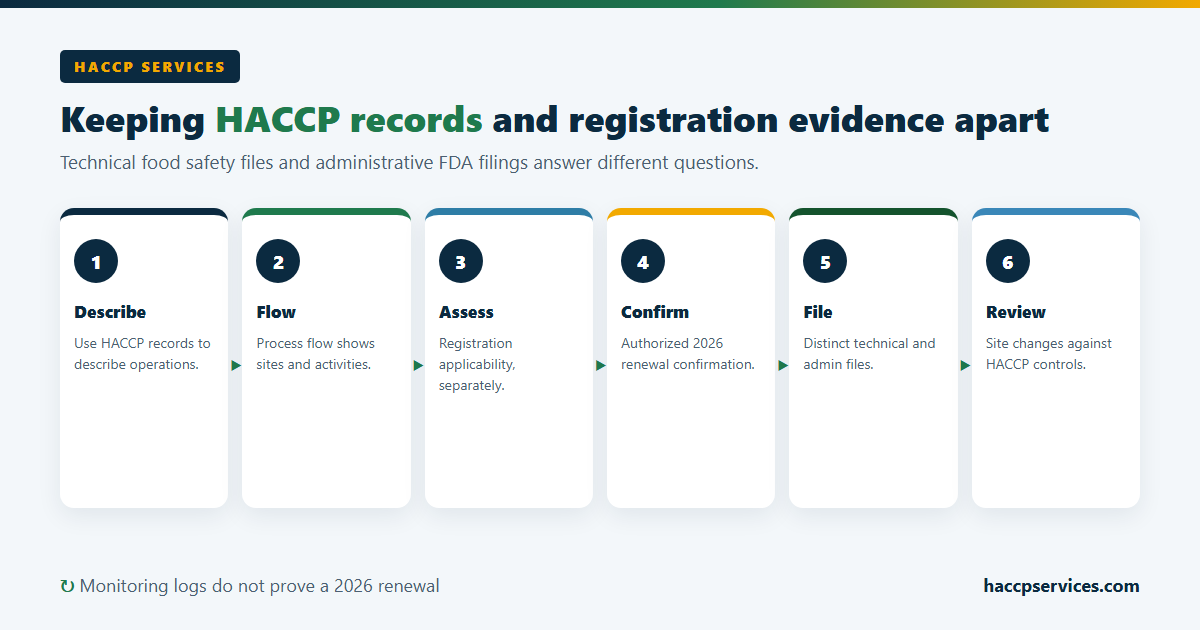
- Identify the role of HACCP records in describing operations.
- Assess registration applicability separately.
- Verify facility-specific 2026 renewal evidence.
- Retain distinct technical and administrative compliance files.
- Assess site changes against HACCP controls on their own.
Related reading
- FDA Registration Renewal 2026 for HACCP-Based Food Operations
- FDA Facility Registration Versus HACCP Responsibilities in 2026
- Mapping Food Handling Activities to FDA Registration Requirements
- Separating Food Facility Roles From HACCP Process Responsibilities
How HACCP Services can help
HACCP Services, a service of Consultare Inc. Group, supports HACCP systems, hazard analysis review, process flow verification and compliance record organization, subject to the engagement scope.
- HACCP implementation support
- HACCP recordkeeping system setup
- HACCP document control
- HACCP regulatory compliance audits
Need help organizing your compliance records?
Discuss your HACCP documentation, registration files and record structure with our team. You can book a free consultation or contact our team.
Start building your compliance system
If you prefer to organize and manage your compliance activities yourself, you can also create a free SystemsBuilder account. Then begin building a structured system for your compliance documentation and processes.
Technical sources: FDA Food Facility Registration User Guide: Biennial Registration Renewal, FDA reminder on biennial renewal requirements, FDA Online Registration of Food Facilities, 21 U.S.C. 350d and 21 CFR Part 1, Subpart H. This article is educational information, not legal advice or an official statement of FDA policy. HACCP Services is not affiliated with FDA. Requirements may change, and applicability depends on your facility’s operations; verify current requirements with official FDA sources.