
FDA facility registration versus HACCP is not a choice between two options: they are two different obligations, and completing one does not satisfy the other. HACCP programs manage food safety hazards that arise from products and processes. FDA Food Facility Registration, by contrast, concerns the regulatory identification of certain establishments.
For the 2026 cycle, covered facilities must renew their registration by December 31, 2026. This article explains who does what, and why each track needs its own review, records and corrective actions.
Quick answer: Your HACCP team owns hazard control. The facility owner, operator, agent in charge or an authorized individual is responsible for the registration renewal submission. Manage them as separate responsibilities with separate evidence.
Who this article is for
This guide is written for HACCP team leaders, quality managers, plant managers and the people who handle FDA submissions for food facilities.
1. What HACCP covers
HACCP is a hazard-based system built on the Codex General Principles of Food Hygiene (CXC 1-1969) and the NACMCF principles. FDA requires HACCP plans for juice (21 CFR Part 120) and seafood (21 CFR Part 123). USDA FSIS requires HACCP for meat and poultry under 9 CFR Part 417. Most other FDA-registered facilities fall under 21 CFR Part 117, where a food safety plan is prepared or overseen by a PCQI (117.126). Our HACCP plan vs FDA food safety plan article compares the two.
2. What FDA facility registration covers
Under section 415 of the Federal Food, Drug, and Cosmetic Act (21 U.S.C. 350d), food facilities required to register must renew between October 1 and December 31 of every even-numbered year. 21 CFR 1.225 describes who must register, and 21 CFR 1.226 lists who does not. Therefore, evaluate applicability and any exemptions for each individual facility.
3. Key 2026 renewal facts
The 2026 deadline is December 31, 2026. FDA states that an earlier update does not replace the biennial renewal. Also, FDA does not charge a renewal fee.
4. Who is responsible for each track
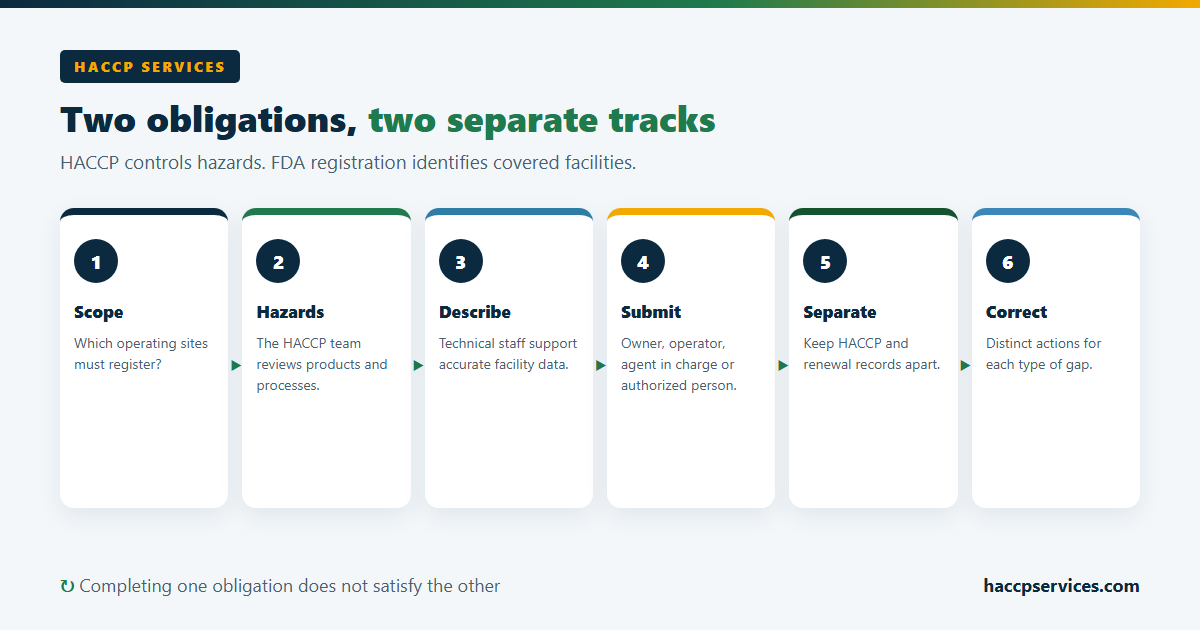
Technical staff can support accurate facility descriptions and records. However, the facility owner, operator, agent in charge or an authorized individual is responsible for making the renewal submission. Meanwhile, HACCP program adequacy requires a separate technical review. Our HACCP hazard analysis guide covers that review.
5. Keep the evidence separate
Maintain HACCP records separately from the FDA renewal confirmation. Monitoring logs, verification records and the plan itself belong in the HACCP file. The renewal confirmation belongs in a regulatory compliance file. See HACCP recordkeeping requirements for the records the HACCP side needs.
6. Use distinct corrective actions
A hazard-control gap and a registration issue have different causes and owners. So, use distinct corrective actions for each. For HACCP deviations, follow your HACCP corrective actions procedure. For registration issues, route the correction to the person authorized to submit.
Frequently asked questions
Does completing a HACCP plan satisfy FDA registration?
No. HACCP and FDA facility registration are separate obligations, and completing one does not satisfy the other.
Who submits the 2026 FDA registration renewal?
The facility owner, operator, agent in charge or an authorized individual makes the renewal submission. Technical staff can support accurate information.
Can an earlier registration update replace the renewal?
No. FDA states that an earlier update does not replace the biennial renewal.
Registration and HACCP separation checklist
- Confirm whether each operating site is required to register.
- Maintain HACCP records separately from the FDA renewal confirmation.
- Verify who is authorized to submit the renewal.
- Record completion of the 2026 renewal.
- Use distinct corrective actions for hazard-control gaps and registration issues.
- Review HACCP program adequacy as a separate activity.
Related reading
- FDA Registration Renewal 2026 for HACCP-Based Food Operations
- HACCP Records and FDA Registration: What They Can and Cannot Prove
- Separating Food Facility Roles From HACCP Process Responsibilities
- Facility Changes That May Trigger FDA Registration Review
How HACCP Services can help
HACCP Services, a service of Consultare Inc. Group, supports HACCP plan design, hazard analysis, process verification and food safety training, and helps coordinate HACCP records with regulatory documentation, subject to the engagement scope.
- HACCP plan development
- Hazard analysis support
- HACCP recordkeeping system setup
- HACCP training management
Need help separating HACCP and registration tasks?
Discuss your food safety and regulatory readiness needs with our team ahead of the 2026 deadline. You can book a free consultation or contact our team.
Start building your compliance system
If you prefer to organize and manage your compliance activities yourself, you can also create a free SystemsBuilder account. Then begin building a structured system for your compliance documentation and processes.
Technical sources: FDA Biennial Registration Renewal User Guide, FDA reminder on biennial renewal requirements, FDA Online Registration of Food Facilities, 21 U.S.C. 350d and 21 CFR Part 1, Subpart H. This article is educational and is not legal advice; HACCP Services is not affiliated with FDA, and specific requirements depend on your facility, operations and applicable regulations. Verify current requirements through official FDA sources.