
FDA registration renewal 2026 is an administrative obligation for covered food facilities, and it runs separately from your HACCP program. A HACCP plan helps you identify and control significant food safety hazards. Registration renewal, in contrast, keeps FDA’s record of your facility current.
Under section 415 of the Federal Food, Drug, and Cosmetic Act (21 U.S.C. 350d) and 21 CFR Part 1, Subpart H, facilities that must register also have to renew. This article explains the 2026 renewal basics from the point of view of a HACCP-based operation.
Quick answer: If your facility must register with FDA, submit the renewal between October 1 and December 31, 2026. An earlier registration update does not count as renewal, FDA charges no renewal fee, and a strong HACCP plan does not replace the renewal.
Who this article is for
This guide is written for food safety managers, HACCP coordinators, quality teams and regulatory contacts at food processing, packing and holding facilities.
1. Why HACCP and registration renewal are separate
HACCP focuses on products and processes. Your team analyzes hazards, sets controls and keeps monitoring records. FDA facility registration, however, concerns the regulatory identification of certain establishments. Therefore, maintaining an effective HACCP plan does not fulfill an applicable FDA registration requirement. Our HACCP hazard analysis guide explains the technical side of the program.
2. Know the 2026 renewal window
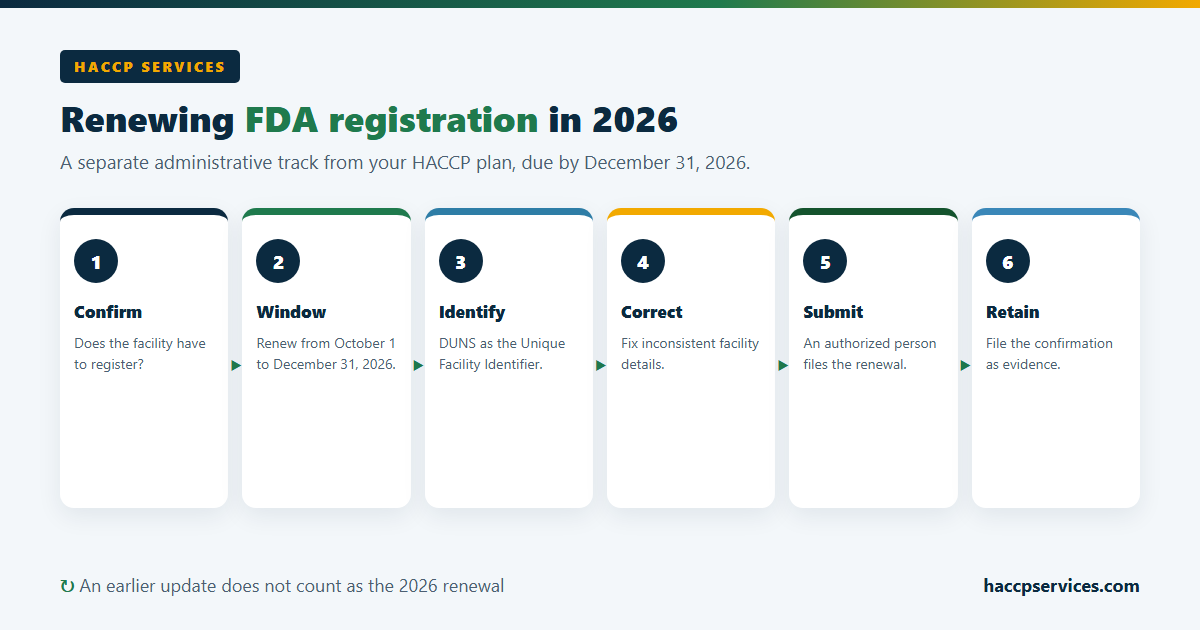
FDA requires facilities subject to registration to renew between October 1 and December 31 of every even-numbered year, as set out in 21 CFR 1.230. The 2026 renewal period closes on December 31, 2026. In addition, FDA does not charge a fee for the renewal.
3. Do not treat an earlier update as renewal
FDA distinguishes a registration update from the biennial renewal. As a result, an update submitted earlier in the cycle does not satisfy the 2026 renewal requirement. Check the renewal status itself, not just the date of the last change.
4. Check your Unique Facility Identifier
FDA currently recognizes the DUNS number as an acceptable Unique Facility Identifier. FDA uses it to verify facility address information. So, before you renew, confirm that the DUNS record and the registration show the same facility details.
5. Keep regulatory records apart from HACCP records
Manage regulatory documentation alongside your operational food safety records, but keep the two distinct. Store renewal evidence in an accessible compliance file. Meanwhile, keep monitoring, corrective action and verification records in the HACCP system. Good HACCP document control makes this separation easy to maintain.
6. Correct inconsistent facility information promptly
Incorrect or inconsistent facility information should be addressed promptly. Assign one owner for the correction and record what changed. For a wider view of how FDA food safety documents fit together, see HACCP plan vs FDA food safety plan.
Frequently asked questions
When does FDA registration renewal 2026 close?
The 2026 renewal period runs from October 1 to December 31, 2026, for facilities that are required to register.
Does a HACCP plan replace FDA facility registration?
No. A HACCP plan controls food safety hazards. Registration is a separate administrative obligation for covered facilities.
Is there a fee to renew an FDA food facility registration?
No. FDA does not charge a registration renewal fee.
Does an earlier registration update count as renewal?
No. FDA states that an earlier update does not replace the biennial renewal.
FDA registration renewal 2026 checklist
- Confirm whether the facility must register with FDA.
- Check whether the 2026 renewal was submitted.
- Verify the DUNS number and facility address details.
- Retain renewal evidence in an accessible compliance file.
- Address incorrect or inconsistent facility information promptly.
- Keep HACCP records and registration records distinct.
More in this series
- FDA Facility Registration Versus HACCP Responsibilities in 2026
- FDA Registration Renewal Across Multiple HACCP Production Sites
- Facility Changes That May Trigger FDA Registration Review
- FDA Registration Responsibilities in Contract Food Manufacturing
- Mapping Food Handling Activities to FDA Registration Requirements
- FDA Registration Renewal Considerations for Food Warehouses
- FDA Registration Requirements for Food Packing and Processing Operations
- Separating Food Facility Roles From HACCP Process Responsibilities
- HACCP Records and FDA Registration: What They Can and Cannot Prove
How HACCP Services can help
HACCP Services, a service of Consultare Inc. Group, supports HACCP plan development, hazard analysis, process flow verification, HACCP training and implementation review, and regulatory compliance coordination, subject to the engagement scope.
- HACCP plan development
- Hazard analysis support
- Facility and process flow review
- HACCP regulatory compliance audits
Need help preparing for the 2026 renewal deadline?
Discuss your facility’s regulatory compliance needs and HACCP records with our team. You can book a free consultation or contact our team.
Start building your compliance system
If you prefer to organize and manage your compliance activities yourself, you can also create a free SystemsBuilder account. Then begin building a structured system for your compliance documentation and processes.
Technical sources: FDA Food Facility Registration User Guide: Biennial Registration Renewal, FDA Online Registration of Food Facilities, 21 U.S.C. 350d and 21 CFR Part 1, Subpart H. This article is educational and is not legal advice; HACCP Services is not affiliated with FDA, and specific requirements depend on your facility, operations and applicable regulations. Verify current requirements through official FDA sources.