
Seafood HACCP Listeria sanitation and tuna histamine controls address two very different risks in the same plant. Ready-to-eat salmon processing raises environmental contamination concerns. Fresh tuna, by contrast, can form scombrotoxin (histamine) when time-temperature control fails. In both cases, a written plan is not enough unless daily operations follow it.
Under 21 CFR Part 123, safety plans must reflect the species, product form, handling method and intended use. This article focuses on how processors that handle both product types can keep sanitation and histamine controls working.
Quick answer
Seafood HACCP requires a product-specific hazard analysis, a written plan for hazards reasonably likely to occur, effective CCP monitoring and sanitation monitoring. Tuna may need histamine controls at receiving and storage. Meanwhile, ready-to-eat fish processing needs robust sanitation and contamination prevention.
Who this article is for
This guide is for processors and HACCP coordinators handling fresh tuna or ready-to-eat seafood, such as smoked or ready-to-eat salmon.
1. Perform a hazard analysis for each fish product
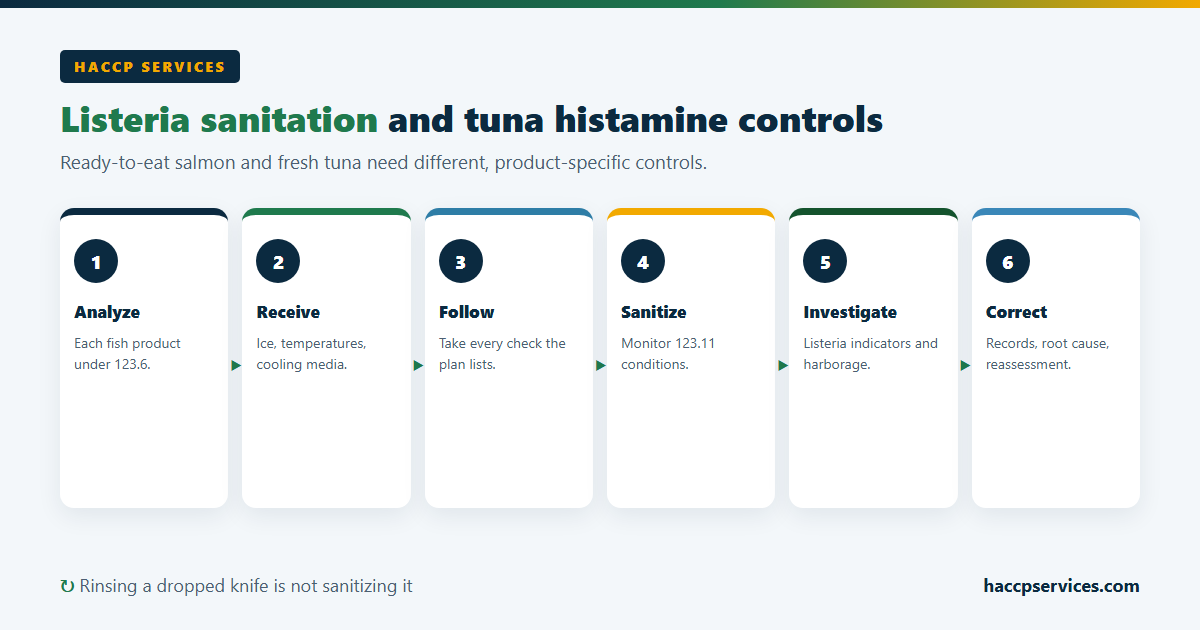
Section 123.6 requires a hazard analysis for each kind of fish and fishery product. So, assess species-specific biological and chemical hazards, intended use, distribution, processing and storage conditions. Our HACCP hazard analysis guide walks through the method.
2. Control tuna histamine at receiving and storage
Where histamine is reasonably likely, evaluate how fish arrives on ice and what internal temperatures or other indicators you check. In addition, review the adequacy of cooling media, storage temperatures and monitoring frequency. Each control should match a supported critical limit. See HACCP critical limits.
3. Follow the written receiving procedures
Employees must take and record each observation or measurement the plan lists at the CCP. For example, if the plan calls for product temperatures, skipping them breaks the plan. Under 21 CFR 123.6(c)(7), records must contain the actual values and observations.
4. Monitor sanitation under 21 CFR 123.11
Section 123.11 requires processors to monitor sanitation conditions and correct problems in a timely manner. Key areas include food-contact surface condition and cleanliness, cross-contamination prevention and employee health and hygiene. Food packaging must also be protected from contamination. For instance, a knife dropped on the floor needs cleaning and sanitizing before it touches food again; a quick rinse is not enough.
5. Investigate environmental Listeria findings
Environmental samples may detect Listeria species other than L. monocytogenes, such as L. welshimeri. These findings still signal conditions where the pathogen could survive. Therefore, look for harborage points, review cleaning methods and adjust controls when results show a pattern. Our article on Listeria and environmental contamination in RTE foods covers this further.
6. Document deviations and corrective actions
Keep monitoring records, product assessments, corrections, root cause evidence and verification results. Under 21 CFR 123.7, corrective actions must keep injurious or adulterated product out of commerce and correct the cause. In addition, reassess the plan whenever results warrant it. See HACCP corrective actions.
Listeria and histamine control checklist
- Confirm which regulations and standards apply to the actual products and operations.
- Document product- and process-specific hazards and supplier responsibilities.
- Review sanitation, personnel hygiene, equipment and food-contact surfaces.
- Verify that written monitoring procedures match records and observed practice.
- Track deviations, root causes, corrective actions and effectiveness evidence.
Frequently asked questions
What is the main HACCP concern with fresh tuna?
For scombrotoxin-forming tuna, poor time-temperature control can allow histamine to form. The specific controls depend on the product and operation.
Does rinsing a dropped knife satisfy sanitation requirements?
Not automatically. Utensils that touch the floor or other insanitary surfaces need proper cleaning and sanitizing before they contact food again.
Can a seafood HACCP plan stay compliant if monitoring steps are skipped?
No. Processors must carry out and document the monitoring procedures their plan specifies.
How HACCP Services can help
HACCP Services, a service of Consultare Inc. Group, supports seafood hazard analysis, HACCP plan development and review, histamine control assessment, receiving and storage monitoring, sanitation monitoring and corrective actions, subject to the engagement scope.
- Seafood HACCP plans (21 CFR 123)
- Environmental monitoring program design
- Sanitation program development
- Corrective action management
Need help with Listeria and histamine controls?
Discuss your products, facilities, suppliers and compliance priorities with our team. You can book a free consultation or contact our team.
Start building your compliance system
If you prefer to organize and manage your compliance activities yourself, you can also create a free SystemsBuilder account. Then begin building a structured system for your compliance documentation and processes.
Technical sources: 21 CFR Part 123 (Fish and Fishery Products), 21 CFR 123.11 (sanitation control procedures) and FDA Fish and Fishery Products Hazards and Controls Guidance. This article is educational; HACCP Services is not affiliated with FDA, and specific requirements depend on your products, processes and applicable regulations.