
Seafood HACCP for cold storage covers more than a cold room thermometer. Receiving, holding, repackaging and vacuum packing fish can each introduce their own hazards. As a result, a cold storage or repacking operation needs critical limits backed by evidence, monitoring that people actually perform, and records that prove it.
Under 21 CFR Part 123, processing includes handling, storing, packing, labeling and holding fish (21 CFR 123.3(k)). Therefore, many warehouses and repackers are seafood processors. Each processor must conduct a hazard analysis and, where hazards are reasonably likely to occur, have and implement a written HACCP plan (21 CFR 123.6).
Quick answer
A cold storage seafood HACCP plan should identify the hazards of each product, set supported receiving and storage critical limits, and state monitoring procedures and frequencies. It also needs records that show the plan is followed. In addition, fish allergen labeling and sanitation still matter when product is repacked.
Who this article is for
This guide is for seafood cold storage operators, refrigerated warehouses, repackers, HACCP coordinators and quality teams.
1. Analyze each kind of fish and each operation
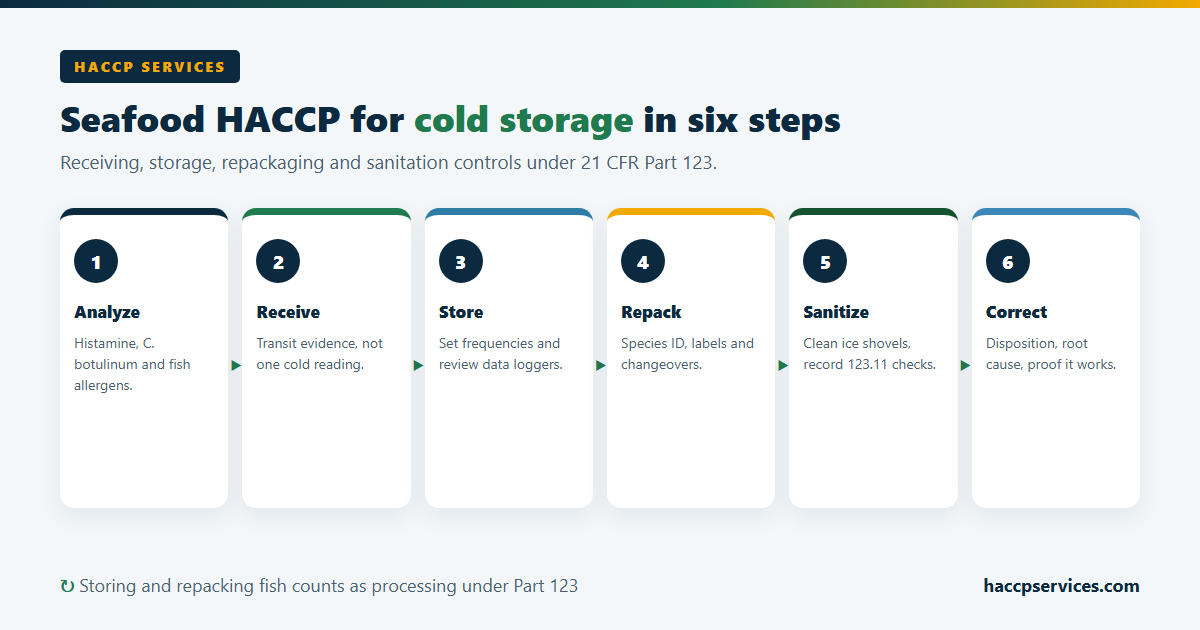
Start with the species and the activity. Scombroid species, such as tuna and mahi-mahi, can form histamine when temperature control fails. Vacuum-packed or other reduced-oxygen products may need Clostridium botulinum controls. Meanwhile, repackaging raises fish allergen and labeling risks. Our HACCP hazard analysis guide explains the method.
2. Base receiving limits on transit evidence
A single cold reading at the dock does not show what happened during transit. Instead, define the transport conditions you accept and the records that demonstrate control, such as continuous temperature data or ice condition. Then write those expectations into the critical limits. For more detail, see HACCP critical limits.
3. Monitor refrigerated storage reliably
Set a clear monitoring frequency for each cold room. If you use data loggers, someone must review the data on a defined schedule and sign the record. In addition, name the person responsible and calibrate the instruments. Our HACCP monitoring procedures page covers the basics.
4. Control fish allergens during repackaging
Fish is a major food allergen under U.S. law, and labels must name the species. When several species share one room or line, mix-ups can cause undeclared allergens. So, check species identity, match each label to the product, control packing materials and manage changeovers. See FDA’s food allergies page for background.
5. Monitor and record sanitation under 21 CFR 123.11
Section 123.11 requires processors to monitor key sanitation conditions and keep records. These include the condition and cleanliness of food-contact surfaces and the prevention of cross-contamination. For example, ice shovels and scoops touch product directly. Therefore, clean them as needed, protect them from contamination and record what you observe.
6. Document corrective actions and verify they work
When a limit is missed, record the deviation, the affected product and its disposition. Next, investigate the cause and revise the plan if needed. Under 21 CFR 123.7, corrective actions must keep injurious or adulterated product out of commerce and correct the cause. Finally, train staff on the change and collect evidence that it works. See HACCP corrective actions.
Cold storage seafood HACCP checklist
- Identify the product, process, responsible operator and applicable FDA requirements.
- Keep written hazard analyses, procedures and records suited to each activity.
- Confirm that transport evidence supports each receiving decision.
- Verify refrigeration monitoring and investigate deviations promptly.
- Review species identification, allergen labeling and segregation during repacking.
- Record sanitation observations, corrective actions and proof of effectiveness.
Frequently asked questions
What hazards can arise in vacuum-packed seafood?
Depending on the product and storage conditions, C. botulinum growth and toxin formation may require specific controls.
Why do scombroid fish need special attention?
Poor temperature control can allow histamine to form. Later chilling does not remove histamine that has already formed.
Can a revised HACCP plan alone close an FDA observation?
Usually not. A revision should come with evidence of implementation, such as monitoring, training and corrective action records.
How HACCP Services can help
HACCP Services, a service of Consultare Inc. Group, supports seafood hazard analysis, critical limit review, receiving and cold storage monitoring procedures, sanitation records and corrective action planning, subject to the engagement scope.
- Seafood HACCP plans (21 CFR 123)
- Cold storage and distribution HACCP plans
- Allergen management program development
- Corrective action management
Need help with your cold storage seafood HACCP plan?
Discuss your products, operations, records and risks with our team. You can book a free consultation or contact our team.
Start building your compliance system
If you prefer to organize and manage your compliance activities yourself, you can also create a free SystemsBuilder account. Then begin building a structured system for your compliance documentation and processes.
Technical sources: 21 CFR Part 123 (Fish and Fishery Products) and FDA Fish and Fishery Products Hazards and Controls Guidance. This article is educational; HACCP Services is not affiliated with FDA, and specific requirements depend on your products, processes and applicable regulations.