
A HACCP prerequisite checklist helps you confirm that sanitation, hygiene, pest control, supplier controls and other foundation programs work before you rely on critical control points. When these programs fail, broad hazards can undermine even a well-designed HACCP plan.
Food manufacturers who want to supply large retailers such as Costco need reliable, documented controls. They also need to explain those controls clearly. This guide sets out practical steps for reviewing prerequisite programs. Regulatory duties depend on the product, the facility and the transaction. Retailer-specific supplier conditions should always be confirmed directly with the buyer.
Quick answer
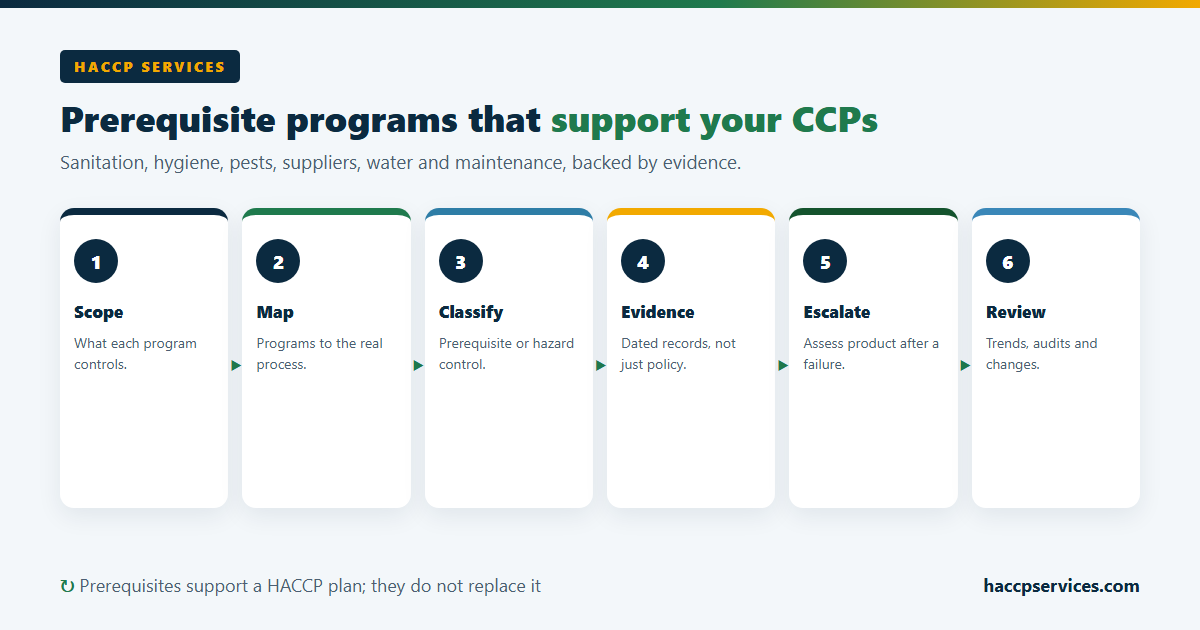
List the prerequisite programs your site runs and map them to the real process. Next, separate them from the specific hazard controls set by your hazard analysis. Then keep dated records that prove each program works, and escalate failures quickly. The NACMCF HACCP guidelines say prerequisite programs should be documented, regularly audited and managed separately from the HACCP plan.
1. Clarify what prerequisites achieve
Prerequisite programs provide the basic environmental and operating conditions for safe food. Typical examples include sanitation, personnel hygiene, pest control, supplier controls and water quality. Equipment maintenance, chemical management and training belong on the list too. Together, they reduce broad hazards that could undermine your HACCP control points. Our article on why prerequisite programs matter for hazard control explores this link.
2. Map prerequisites to the product and process
Assess the actual facility, product categories and routes rather than relying on a generic checklist. In addition, separate cross-functional prerequisite management from the specific hazard controls assigned by the hazard analysis. This distinction matters under FDA rules. For most FDA-registered facilities, 21 CFR 117.135 treats sanitation, allergen and supply-chain controls as preventive controls when a hazard requires them. See our HACCP hazard analysis guide for how those decisions are made.
3. Keep records tied to operational evidence
Use approved procedures, training observations and cleaning verification. Add water results where appropriate, pest activity reviews and corrective action records. An undated policy alone does not prove that a program is in place. Instead, records should show what was done, when and by whom. Our HACCP recordkeeping requirements page outlines what good records contain.
4. Escalate when a prerequisite fails
When sanitation, supplier control or equipment integrity breaks down, investigate quickly. Ask whether the failure could affect product that has already been released. A deviation in a foundation program may call for an immediate food safety evaluation, even if no formal critical limit was breached. For facilities under Part 117, 21 CFR 117.150 sets corrective action duties, including for unanticipated food safety problems. Our HACCP corrective actions page covers the basics.
5. Connect prerequisites to retail readiness
Strong prerequisite programs help suppliers show consistency during talks with Costco or other large retailers. However, they do not prove that every Costco buyer requires a specific HACCP certificate. “HACCP certification” is not a single legal certificate. Buyer expectations vary, so confirm them in writing before you plan an audit.
Frequently asked questions
Are prerequisite programs part of the HACCP plan?
Usually not. NACMCF describes them as the foundation of the HACCP system, managed separately from the plan. Certain aspects can be built into the plan when the hazard analysis calls for it.
Can a prerequisite failure affect released product?
Yes. A sanitation or equipment failure can affect product even when no critical limit was breached, so assess product impact promptly.
Is a written policy enough evidence?
No. Reviewers look for dated records that show the program was carried out and checked.
Supplier readiness checklist
- Confirm the applicable regulation, certification scope and buyer-specific requirements in writing.
- Identify the accountable process owner and the current approved procedures.
- Collect recent objective records tied to the correct facility, product and lots.
- Resolve exceptions with documented corrective actions and effectiveness checks.
- Test record retrieval and make the review package available to authorized reviewers.
How HACCP Services can help
HACCP Services, a service of Consultare Inc. Group, supports prerequisite program gap assessments, sanitation and supplier programs, recordkeeping and regulatory readiness, subject to the engagement scope.
- Prerequisite programs (PRP) gap assessment and development
- HACCP sanitation program development
- HACCP supplier program evaluation
- HACCP certification and third-party audit preparation
Need help with your prerequisite programs?
Share your product category, manufacturing location, current program and expected distribution timeline. Then we can focus on the gaps that matter most. You can book a free consultation or contact our team.
Start building your compliance system
If you prefer to organize and manage your compliance activities yourself, you can also create a free SystemsBuilder account. Then begin building a structured system for your compliance documentation and processes.
Technical sources: FDA / NACMCF HACCP Principles and Application Guidelines, FSMA Final Rule for Preventive Controls for Human Food, 21 CFR 117.135 and 21 CFR 117.150. This article is educational, not legal advice or a statement of Costco supplier approval policy. HACCP Services is independent of Costco Wholesale and FDA, and does not claim affiliation, endorsement or authority to approve suppliers. Requirements may change, so confirm current rules and written buyer terms before relying on this guide.