
Seafood HACCP for crab meat depends on keeping refrigerated pasteurized crab meat cold at every step, because temperature abuse can allow Clostridium botulinum to grow and form toxin. FDA seafood HACCP enforcement keeps showing that a written plan is not enough: critical limits, monitoring and corrective actions must actually be carried out and recorded.
Under 21 CFR Part 123, processors must have and follow a HACCP plan for each reasonably likely hazard. This article walks through receiving and storage controls for refrigerated pasteurized canned crab meat, a product where FDA has cited firms for gaps.
Who this article is for
This guide is written for seafood processors, refrigerated seafood distributors, HACCP coordinators and quality teams handling pasteurized crab meat.
1. Analyze C. botulinum hazards for pasteurized crab meat
Review the specific product and process, including the difference between proteolytic and non-proteolytic C. botulinum. Then set scientifically justified controls in line with FDA’s Fish and Fishery Products Hazards and Controls Guidance. Our HACCP hazard analysis guide explains the method.
2. Write receiving CCP limits for each transport method
For refrigerated shipments without ice, FDA identified an ambient temperature of 40°F or below, continuously monitored during transit, as an appropriate receiving criterion in the case it cited. For iced shipments, FDA described complete ice coverage at delivery with representative checks. Always confirm the limits that apply to your actual product against the FDA guidance. See HACCP critical limits.
3. Verify the storage CCP
Where storage uses mechanical refrigeration without ice, FDA described a cooler ambient temperature at or below 40°F with continuous monitoring and daily review of recorded data. Other storage methods need their own documented controls.
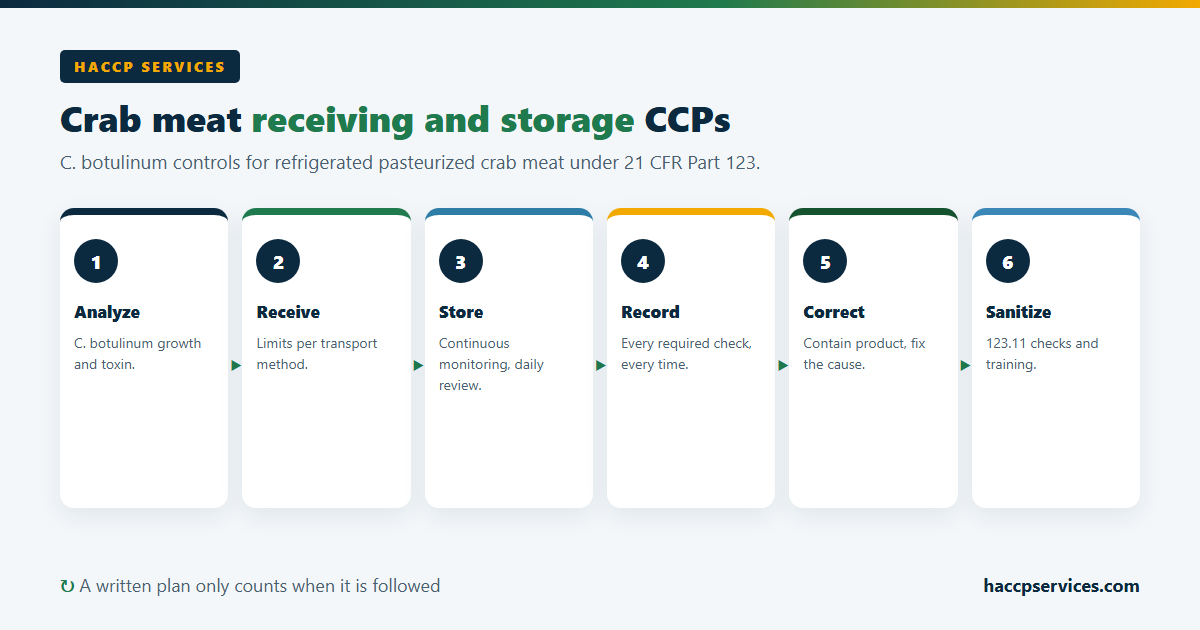
4. Perform and record every monitoring check
Train staff to use the specified temperature devices or to inspect ice coverage, and keep complete receiving and storage records. Calibrated instruments make these records trustworthy; see HACCP monitoring procedures.
5. Define corrective actions that protect product and fix the cause
When a limit is not met, contain the affected product, evaluate cumulative temperature exposure, decide disposition and fix the underlying cause, such as unreliable transport, cooler failure or handling practices. Under 21 CFR 123.7, corrective actions must keep adulterated product out of commerce and correct the cause. See HACCP corrective actions.
6. Integrate sanitation monitoring and training
Keep the sanitation monitoring required by 21 CFR 123.11, including protection from condensate, suitable sanitizer concentration and clean food-contact surfaces, and document food hygiene training. For other seafood hazards, see our article on seafood HACCP histamine, parasites and botulism controls.
Frequently asked questions
Why is pasteurized crab meat sensitive to temperature abuse?
Pasteurization does not make it shelf-stable. Refrigerated pasteurized crab meat may support C. botulinum growth and toxin formation if temperatures rise.
Does a written HACCP plan prove compliance?
No. Critical limits, monitoring, records, corrective actions and verification must actually be carried out.
What must seafood HACCP corrective actions address?
They must prevent potentially adulterated product from entering commerce and correct the cause of the deviation, consistent with 21 CFR 123.7.
Crab meat seafood HACCP checklist
- Confirm the product, facility activity and applicable FDA framework.
- Verify that procedures match actual receiving, storage and handling conditions.
- Assign monitoring responsibilities, critical limits and record review.
- Escalate missing records, deviations and potentially affected product.
- Keep sanitation and training records appropriate to the site.
- Track corrective action owners, deadlines, evidence and effectiveness.
How HACCP Services can help
HACCP Services, a service of Consultare Inc. Group, supports seafood hazard analysis, CCP development, scientifically supported receiving and storage limits, monitoring and record templates, sanitation controls and corrective action procedures, subject to the engagement scope.
- Seafood HACCP plans (21 CFR 123)
- HACCP plan validation and scientific justification
- CCP monitoring system design
- Corrective action management
Need help with your seafood HACCP plan?
Discuss your products, process, records and risks with our team. You can book a free consultation or contact our team.
Start building your compliance system
If you prefer to organize and manage your compliance activities yourself, you can also create a free SystemsBuilder account. Then begin building a structured system for your compliance documentation and processes.
Technical sources: 21 CFR Part 123 (Fish and Fishery Products) and FDA Fish and Fishery Products Hazards and Controls Guidance. This article is educational; HACCP Services is not affiliated with FDA, and specific requirements depend on your products, processes and applicable regulations.