
Equipment lubrication keeps lines running, but leaks, excess application and poorly placed lubrication points can create chemical contamination concerns near food. Lubricant can also collect dust and product residue, which makes cleaning harder. This article explains how lubrication becomes a sanitary design risk and how to manage it within a HACCP-based food safety program.
The aim is not to stop lubricating. Instead, the aim is to make sure lubricant stays where it belongs and that any contact with food is anticipated and controlled.
Quick answer
Map every lubrication point near exposed product. Choose a lubricant that suits each point, and apply only the amount needed. Inspect leak-prone seals, gearboxes and bearings on a schedule. Store and dispense lubricants in labeled, segregated containers. When a leak or drip reaches product or packaging, hold the affected product, fix the source and record what happened.
How lubrication creates hazards
Lubricant becomes a food safety problem in a few predictable ways:
- Location. Bearings, chains and gearboxes mounted above open product can drip directly into it.
- Over-application. Excess grease squeezes out of fittings and spreads to nearby surfaces.
- Worn seals. Failing seals on gearboxes and hydraulic parts release oil over time.
- Wrong product. A lubricant not suited to possible food contact may be used at a point where contact can occur.
- Poor storage and dispensing. Unlabeled containers and shared grease guns increase the chance of using the wrong lubricant.
In addition, greasy surfaces trap dust and product fines. As a result, a lubrication issue can become a cleaning issue as well.
What the rules expect
For most FDA-registered facilities, 21 CFR 117.40(a)(2) requires equipment to be designed, constructed and used appropriately to avoid adulteration of food with lubricants, fuel, metal fragments, contaminated water or other contaminants. Section 117.40(a)(3) adds that equipment must be installed so that it and adjacent spaces can be cleaned and maintained.
Lubricants intended for locations with possible food exposure are addressed in 21 CFR 178.3570, lubricants with incidental food contact. That section also states that the amount used is the minimum required to achieve the technical effect. In other words, choosing a suitable lubricant does not make leaks or over-application acceptable.
Finally, the hazard analysis under 21 CFR 117.130 must consider chemical hazards and the condition, function and design of equipment. HACCP is mandatory in the U.S. only for juice (21 CFR Part 120), seafood (Part 123) and USDA-inspected meat and poultry (9 CFR Part 417). Elsewhere, HACCP follows the Codex General Principles of Food Hygiene (CXC 1-1969).
Hazard analysis or prerequisite program?
For most sites, lubrication control belongs in prerequisite programs. These typically include preventive maintenance, lubricant selection, storage and post-maintenance cleaning. However, the hazard analysis should still name lubricant contamination as a potential chemical hazard where product is exposed. Then it should explain which programs control it.
If a specific line has a history of leaks over open product, the team may decide a stronger control is needed. Our HACCP hazard analysis page explains how to evaluate severity and likelihood. The HACCP prerequisite checklist shows how maintenance programs support the plan.
Practical review steps
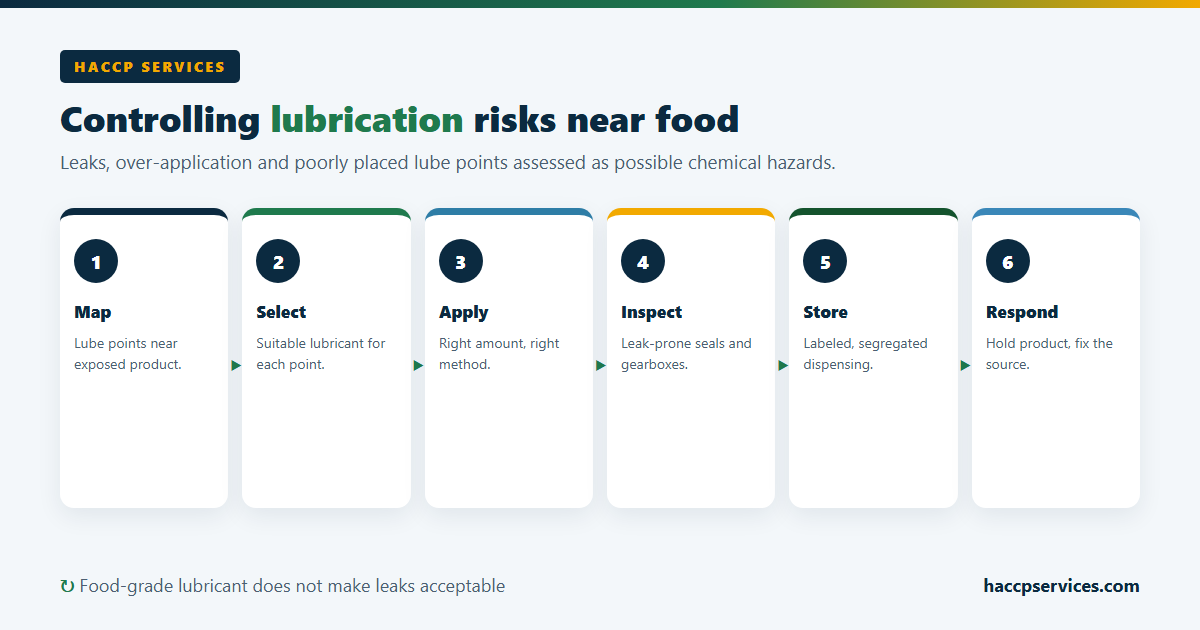
- Map lubrication points. List each point near exposed product, packaging or food-contact surfaces. Note what sits directly below it.
- Select a suitable lubricant. Match each point to a lubricant suited to its risk of food contact. Keep supplier documentation.
- Control application. Define the amount, frequency and method. Remove excess after each task.
- Inspect leak-prone points. Check seals, gearboxes, bearings and hydraulic lines on a schedule. Add drip trays or guards where design allows.
- Control storage and dispensing. Label containers and grease guns. Segregate lubricants by type and keep them away from ingredients and packaging.
- Respond to incidents. Hold potentially affected product, clean the area, repair the source and record the decision.
Records to keep
- A lubrication point register with the lubricant approved for each point.
- Supplier documentation for lubricants used where food contact may occur.
- Preventive maintenance and lubrication task records.
- Leak inspections, findings and repair records.
- Incident, product hold and corrective action records, with closure evidence.
Example scenario
During a pre-operational check, a supervisor sees oil spots on a conveyor belt below a gearbox. Production had run the previous shift. The team stops the line and places product from that shift on hold.
Next, maintenance finds a failing gearbox seal. The team records the condition, the potential chemical hazard and the affected product. A qualified person then evaluates the product and decides on disposition. Afterward, the seal is replaced, a drip tray is added and the area is cleaned. Finally, the team adds the gearbox to a closer inspection schedule and checks that no new leaks appear. See our page on HACCP corrective actions for the wider process.
Frequently asked questions
Does using a food-grade lubricant solve the risk?
No. A suitable lubricant reduces the risk from incidental contact. Leaks, excess grease and poor placement still need control.
Is lubrication a CCP?
Usually not. Most sites manage it through maintenance and prerequisite programs. The hazard analysis decides whether any step needs a stronger control.
Who should be involved in the review?
Food safety, maintenance, sanitation and production should review lubrication risks together, because each group sees a different part of the problem.
Equipment lubrication checklist
- Map lubrication points above or near exposed product.
- Approve a suitable lubricant for each point.
- Define application amounts and remove excess.
- Inspect seals, gearboxes and bearings on a schedule.
- Label, segregate and control lubricant storage.
- Hold product, fix the source and record each incident.
How HACCP Services can help
HACCP Services, a service of Consultare Inc. Group, supports maintenance control reviews, risk documentation, training discussions and corrective action planning, subject to the engagement scope. Facility management keeps responsibility for approving and implementing changes, and we do not promise certification, regulatory approval or a particular audit outcome.
- Preventive maintenance and food safety integration
- Prerequisite program gap assessment
- Corrective action management
- Product hold, release and disposition
Need help with equipment lubrication risks?
Discuss your equipment, maintenance practices and records with our team. You can book a free consultation or contact our team.
Start building your compliance system
If you prefer to organize and manage your compliance activities yourself, you can also create a free SystemsBuilder account. Then begin building a structured system for your compliance documentation and processes.
Technical sources: 21 CFR 117.40 (equipment and utensils), 21 CFR 178.3570 (lubricants with incidental food contact), 21 CFR 117.130 (hazard analysis) and the Codex General Principles of Food Hygiene (CXC 1-1969). This article is educational and is not legal advice; HACCP Services is not affiliated with FDA, and specific requirements depend on your products, processes and applicable regulations.