
HACCP product and process changes can affect both your hazard controls and the information on your FDA facility registration, even when the physical site stays the same. A manufacturer may add a new product type, switch a cooking method or start packing a new line. The HACCP documentation may then need revision.
However, the registration question should be evaluated separately. This article explains how to run both reviews side by side, what each one checks and how to confirm the 2026 renewal by December 31, 2026.
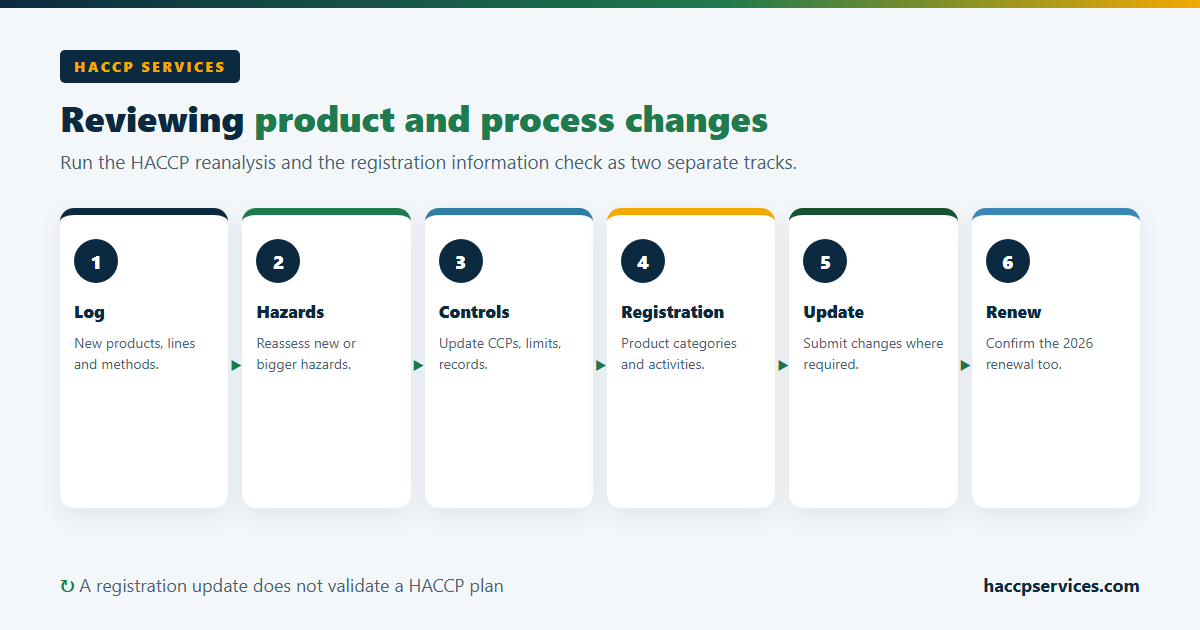
Quick answer: Log every product and process change. Reassess hazards and controls through your HACCP process. Separately, check whether required registration information, such as food product categories or activity types, has changed and needs an update. Then confirm the 2026 renewal. A registration update or renewal does not validate the HACCP plan.
Who this article is for
This guide is written for HACCP teams, product development and R&D staff, plant managers and regulatory contacts who manage new products and process changes.
1. Log changes as they happen
Start with a single change log. Record new products, new ingredients, new equipment, changed processing steps and new packaging formats. Note the date, the site and the person responsible.
This log feeds both reviews. A structured food safety change management process keeps it complete. Without it, changes slip through between departments.
2. Reassess hazards for each change
HACCP principles call for review when products or processes change. A new product may bring new allergens, a different pathogen profile or a new physical hazard. Similarly, a changed cooking or cooling step may change a critical limit.
Therefore, update the flow diagram and the hazard analysis first. Our guide to hazard analysis for new food products walks through this step. Then review critical control points, critical limits, monitoring and records.
3. Apply the Part 117 reanalysis rules where they apply
Many FDA-registered facilities follow 21 CFR Part 117 rather than a mandatory HACCP rule. Under 21 CFR 117.170, a facility must reanalyze its food safety plan, or the relevant part of it, whenever a significant change in activities creates a reasonable potential for a new hazard or a significant increase in a previously identified hazard. The plan as a whole must also be reanalyzed at least once every three years.
For seafood, juice and meat and poultry, the relevant HACCP regulation sets its own reassessment duties. Check the rule that applies to your products.
4. Check the registration information separately
FDA registration holds specific information about each facility. Under 21 CFR 1.232, this includes the applicable food product categories of food handled at the facility, as identified on Form FDA 3537, and the type of activity conducted for each category.
So, a new product type may mean a new food product category. Likewise, a new activity, such as starting to repack or relabel, may change the activity type. Check each logged change against the registration record.
5. Submit updates when required
Under 21 CFR 1.234, a facility must update its registration within 60 calendar days of any change to the information previously submitted under 21 CFR 1.232, except a change of owner, which follows its own procedure. Assign one person to decide whether an update is needed and to file it.
Keep the reasoning on file. If no update is needed, record why. For broader site changes, see our related article on facility changes that may trigger FDA registration review.
6. Confirm the 2026 renewal as well
An update and a renewal are different submissions. Under section 415 of the Federal Food, Drug, and Cosmetic Act (21 U.S.C. 350d) and 21 CFR 1.230, facilities required to register must renew between October 1 and December 31 of each even-numbered year. Therefore, an update earlier in 2026 does not replace the 2026 renewal, which is due by December 31, 2026.
FDA currently recognizes the DUNS number as an acceptable Unique Facility Identifier and does not charge a renewal fee. For the full renewal picture, see our FDA registration renewal 2026 overview.
An example workflow
- R&D logs a new product that adds a baked item to a site that made only frozen meals.
- The HACCP team updates the flow diagram and hazard analysis for the new line.
- The team reviews CCPs, critical limits and monitoring, and validates new controls where needed.
- The regulatory contact checks whether the food product categories on the registration change.
- If they do, an update is filed within the required time, and the reasoning is recorded.
- The regulatory contact separately confirms the 2026 renewal for the site.
Common mistakes
- Updating the HACCP plan but forgetting the registration information.
- Filing a registration update and treating it as the 2026 renewal.
- Assuming a registration update shows that the HACCP plan is adequate.
- Launching a product before hazards and controls are reassessed.
Frequently asked questions
Does a new product always require a registration update?
Not always. It depends on whether the change affects information already submitted, such as food product categories or activity types. Check each change and record the outcome.
Does a registration update validate our HACCP plan?
No. A registration update is administrative. HACCP controls must be reassessed and, where needed, validated through your technical process.
If we updated our registration this year, do we still need to renew?
Yes, if the facility is required to register. The 2026 renewal is due by December 31, 2026.
HACCP product and process change checklist
- Document changes in products and activities.
- Review HACCP hazard implications and update controls.
- Assess any FDA registration information changes.
- Submit updates within the required time, where needed.
- Verify current 2026 renewal evidence for the facility.
- Keep technical and regulatory records separate.
Related reading
- FDA Registration Renewal 2026 for HACCP-Based Food Operations
- Facility Changes That May Trigger FDA Registration Review
- HACCP Hazard Analysis for New Food Products
- HACCP Records and FDA Registration: What They Can and Cannot Prove
How HACCP Services can help
HACCP Services, a service of Consultare Inc. Group, supports HACCP plan reanalysis, process and product reviews, hazard assessments and regulatory documentation, subject to the engagement scope.
- New product and process change impact assessment
- HACCP plan reassessment
- HACCP plan validation
- Food safety change management
Need help reviewing product and process changes?
Discuss your new products, process changes and records with our team before the December 31, 2026 deadline. You can book a free consultation or contact our team.
Start building your compliance system
If you prefer to organize and manage your compliance activities yourself, you can also create a free SystemsBuilder account. Then begin building a structured system for your compliance documentation and processes.
Technical sources: FDA Biennial Registration Renewal User Guide, FDA reminder on biennial renewal requirements, FDA Online Registration of Food Facilities, 21 U.S.C. 350d, 21 CFR Part 1, Subpart H and 21 CFR 117.170 (reanalysis). This article is educational and is not legal advice or an official statement of FDA policy; HACCP Services is not affiliated with FDA, and specific requirements depend on your facility, operations and applicable regulations. Verify current requirements through official FDA sources.