
Food facility roles and HACCP process responsibilities are two different questions. A HACCP plan explains how hazards are controlled in a process, while FDA Food Facility Registration depends on which physical facility manufactures, processes, packs or holds food. When several businesses touch one product, it is easy to mix them up.
A single product may pass through processors, co-packers, storage providers, distributors and brand owners. Each party can carry different duties under food safety and registration rules. This guide shows how a facility role review keeps those duties clear during the 2026 renewal period.
Quick answer
HACCP documentation describes process hazards and controls. It should not be used on its own to decide which party must register a physical facility. Instead, a facility role review links each processing or holding activity to the responsible establishment. It then checks whether registration applies and requests 2026 renewal confirmation where appropriate.
Who this article is for
This guide is for brand owners, co-packers, storage providers, HACCP coordinators and quality teams who share products across more than one business or site.
1. Why HACCP documents do not answer the registration question
A HACCP plan focuses on the process. It covers hazards, critical control points, monitoring and corrective actions. However, it does not identify the owner, operator or agent in charge of each building. Under 21 CFR 1.225, registration is tied to the facility and to the owner, operator or agent in charge of it. As a result, the registration question needs its own review.
2. Map every physical site and activity
Start with a list of each physical processing, packing or holding site. Next, note which activity happens at each location. A verified process flow diagram is a useful starting point, because it already shows where product moves. Even so, the flow diagram only describes activities; it does not settle registration duties.
3. Identify operators and contract arrangements
For each site, record the business that operates it. Then review the relevant contracts, such as co-packing, storage or distribution agreements. A brand owner may hold the HACCP plan for a product, while a co-packer runs the plant that makes it. In that case, the two roles must be assessed separately.
4. Assess registration applicability site by site
Registration rules sit in 21 U.S.C. 350d and 21 CFR Part 1, Subpart H. Exemptions are listed in 21 CFR 1.226, and key terms are defined in 21 CFR 1.227. Facility applicability and exemptions require an individual assessment. Therefore, avoid assuming that one party’s status covers every site in the chain.
5. Know the 2026 renewal facts
Facilities subject to FDA Food Facility Registration must renew between October 1 and December 31 of each even-numbered year (21 CFR 1.230). The 2026 renewal period closes on December 31, 2026. A registration update made earlier is not the same as the biennial renewal. FDA currently recognizes the DUNS number as an acceptable Unique Facility Identifier, used to verify the facility address. FDA charges no fee for renewal.
6. Keep registration evidence apart from HACCP controls
Review registration obligations separately from HACCP controls. Then retain facility-specific renewal evidence where it applies. Meanwhile, keep your HACCP plan focused on process hazards, so that each file answers its own question. Our guide to HACCP plan vs FDA food safety plan explains a related boundary for FDA-regulated plants.
Frequently asked questions
Does the brand owner’s HACCP plan cover the co-packer’s registration?
No. A HACCP plan describes process controls. Registration depends on the physical facility and the party responsible for it, so each site needs its own assessment.
Is an earlier registration update enough for 2026?
No. An update made earlier is not the same as the biennial renewal, which must be submitted between October 1 and December 31, 2026.
Is there an FDA fee for renewal?
No. FDA does not charge a fee for food facility registration renewal.
Food facility role review checklist
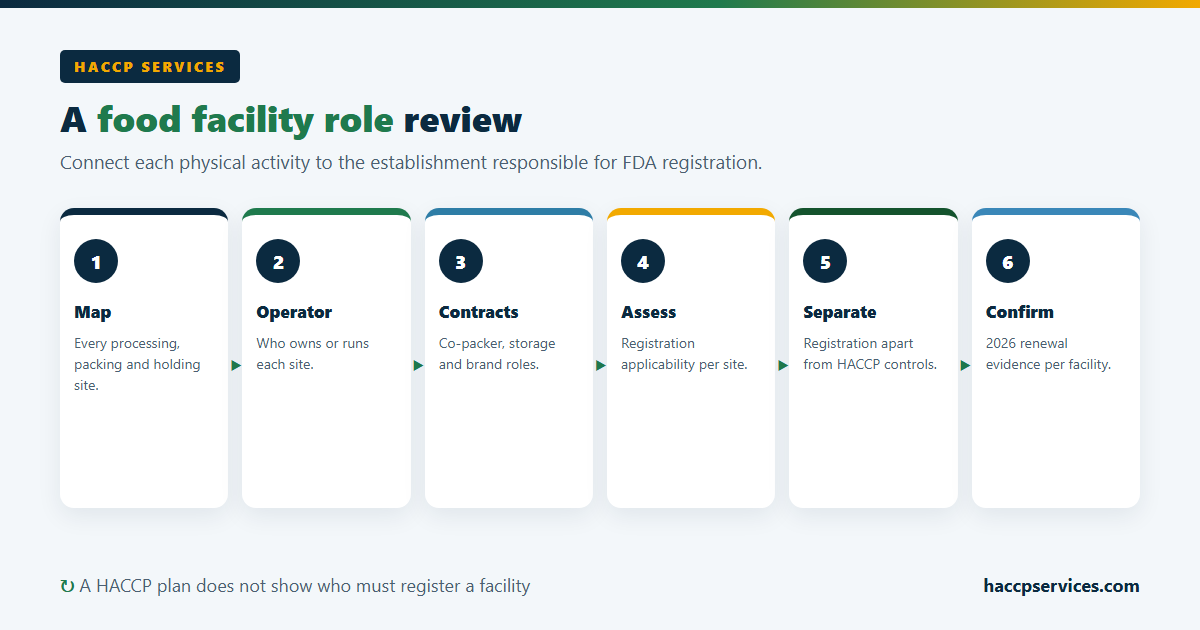
- Map each physical processing, packing or holding site.
- Identify facility operators and relevant contractual arrangements.
- Assess registration applicability and exemptions for each site.
- Review registration obligations separately from HACCP controls.
- Retain facility-specific 2026 renewal evidence where applicable.
Related reading
- FDA Registration Renewal 2026 for HACCP-Based Food Operations
- FDA Facility Registration Versus HACCP Responsibilities in 2026
- FDA Registration Responsibilities in Contract Food Manufacturing
- HACCP Records and FDA Registration: What They Can and Cannot Prove
How HACCP Services can help
HACCP Services, a service of Consultare Inc. Group, supports HACCP planning, process flow review, facility responsibility mapping and food safety documentation, subject to the engagement scope.
- HACCP plan development
- Facility and process flow review
- Multi-site HACCP program standardization
- HACCP document control
Need help mapping facility roles?
Discuss your sites, partners, registration questions and HACCP documentation with our team. You can book a free consultation or contact our team.
Start building your compliance system
If you prefer to organize and manage your compliance activities yourself, you can also create a free SystemsBuilder account. Then begin building a structured system for your compliance documentation and processes.
Technical sources: FDA Food Facility Registration User Guide: Biennial Registration Renewal, FDA reminder on biennial renewal requirements, FDA Online Registration of Food Facilities, 21 U.S.C. 350d and 21 CFR Part 1, Subpart H. This article is educational information, not legal advice or an official statement of FDA policy. HACCP Services is not affiliated with FDA. Requirements may change, and applicability depends on your facility’s operations; verify current requirements with official FDA sources.