
Tuna histamine and salmon receiving controls are two areas where FDA seafood HACCP enforcement finds recurring gaps. In one FDA warning letter, the agency cited missing or inadequate HACCP elements for fresh tuna and salmon, along with an importer verification issue. The lessons apply to any firm that receives, cuts or packs fresh fish.
Under 21 CFR Part 123, processors must analyze reasonably likely hazards for each kind of fish. Where such hazards exist, the HACCP plan must list critical control points, critical limits, monitoring, corrective actions, verification and records (21 CFR 123.6). Fresh tuna and salmon intended for raw or cooked consumption each deserve a product-specific review.
Quick answer
For tuna, the plan must address histamine formation from time-temperature abuse. For salmon and other fresh fish, receiving limits must reflect how the product was kept cold in transit. In addition, fish allergen labeling must be correct. Importers also need written verification procedures under 21 CFR 123.12, unless an FDA agreement covers the product.
Who this article is for
This guide is for fresh fish processors, seafood importers, HACCP coordinators and quality teams handling tuna, salmon and similar products.
1. Assess histamine formation in tuna
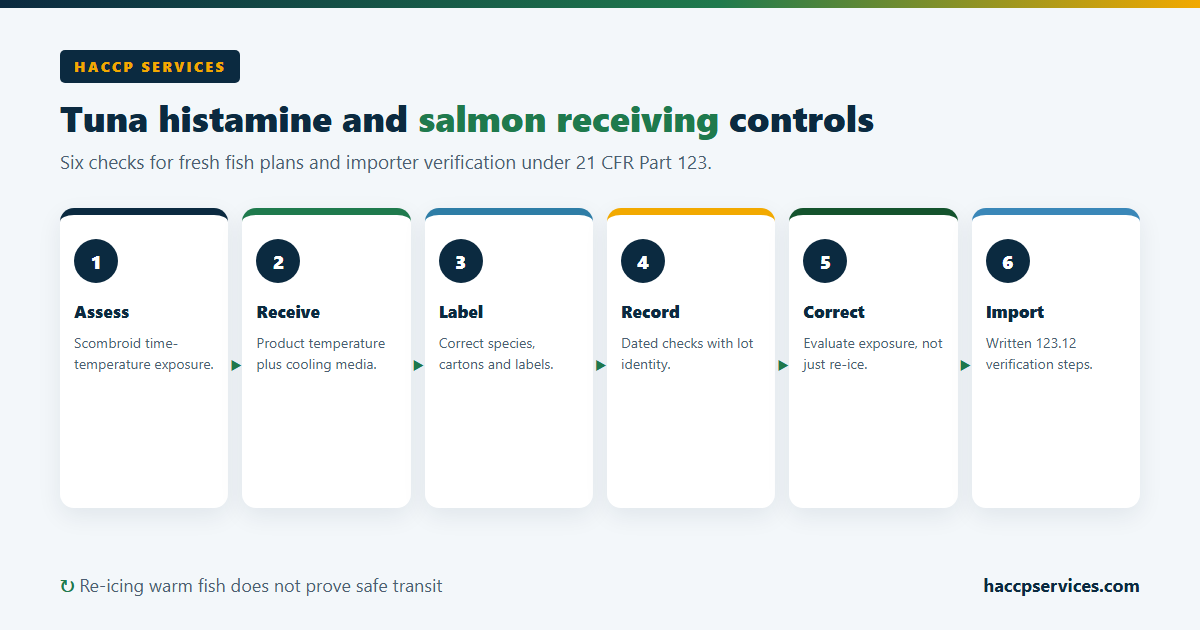
Tuna is a scombrotoxin-forming species. Therefore, evaluate the cumulative time the fish spends above adequate refrigeration, from harvest through processing. Then identify the critical control points that apply, such as receiving, storage and processing steps. Our earlier article on seafood HACCP histamine, parasites and botulism gives broader background.
2. Justify salmon receiving limits
Receiving limits should be scientifically justified. For example, product temperature alone may not show whether the fish stayed cold during transit. So, consider checking the remaining ice or other cooling media, along with transport records. See HACCP critical limits for how to set them.
3. Prevent undeclared fish allergens
Fish is a major food allergen, and labels must name the species. Consequently, confirm species identity at receiving and control cartons and labels. Mix-ups between tuna, salmon and other species can lead to undeclared allergens and recalls.
4. Capture monitoring evidence at every CCP
If the plan calls for receiving or packing checks at set frequencies, staff must perform and record them. Each record should be dated and show clear product and lot identification. Under 21 CFR 123.6(c)(7), records must contain the actual values and observations. Our HACCP monitoring procedures page explains good practice.
5. Design corrective actions that assess exposure
Putting warm fish back on ice does not tell you how long it was warm during transit. Instead, evaluate the affected product, decide its disposition and fix the cause. Under 21 CFR 123.7, corrective actions must keep injurious or adulterated product out of commerce. They must also correct the cause of the deviation. See HACCP corrective actions.
6. Verify imports under 21 CFR 123.12
Every importer of fish must either source from a country with an active FDA memorandum of understanding covering the product, or follow written verification procedures. Those procedures must list product specifications and affirmative steps. Examples include obtaining the foreign processor’s HACCP and sanitation records for the lot, holding a certificate from a competent authority, or inspecting the foreign facility. Importers must keep English-language records of these steps.
7. Keep the plan product-specific and current
Reassess the hazard analysis and HACCP plan whenever products, processes, suppliers or evidence change. Under 21 CFR 123.8, reassessment is also required at least annually. In addition, audit how the plan works on the floor, not just the written document.
Tuna and salmon HACCP checklist
- Confirm the seafood HACCP and importer requirements for each product and activity.
- Check that hazard analyses cover species-specific pathogen, histamine and allergen risks.
- Compare receiving temperatures, transport evidence and forms against procedures.
- Verify product identification, approved cartons and species-specific labels.
- Record deviations, product disposition and corrective action effectiveness.
- Keep supplier, import verification and traceability evidence current.
Frequently asked questions
Why is histamine a concern in tuna?
Time-temperature abuse in susceptible fish can allow histamine to form. Later cooling does not reliably remove histamine that has already formed.
Why check cooling media at receipt?
Product temperature alone may not show whether refrigerated conditions held throughout transit. Ice or other cooling media add evidence.
Can one HACCP plan cover every seafood product?
A plan may group products or production methods only when the hazards, critical control points, critical limits and procedures are identical (21 CFR 123.6(b)).
How HACCP Services can help
HACCP Services, a service of Consultare Inc. Group, supports seafood hazard analysis and plan development, CCP and critical limit review, receiving controls, monitoring records, importer verification procedures, corrective actions and training, subject to the engagement scope.
- Seafood HACCP plans (21 CFR 123)
- Supplier program evaluation
- HACCP plan validation and scientific justification
- Corrective action management
Need help with tuna and salmon HACCP controls?
Discuss your seafood products, operations, records and priorities with our team. You can book a free consultation or contact our team.
Start building your compliance system
If you prefer to organize and manage your compliance activities yourself, you can also create a free SystemsBuilder account. Then begin building a structured system for your compliance documentation and processes.
Technical sources: 21 CFR Part 123 (Fish and Fishery Products), 21 CFR 123.12 (imported products) and FDA Fish and Fishery Products Hazards and Controls Guidance. This article is educational; HACCP Services is not affiliated with FDA, and specific requirements depend on your products, processes and applicable regulations.