
Supplement disease claims and HACCP hazard analysis answer two different questions. HACCP is a method for identifying and controlling food safety hazards. A claim that a product treats or prevents disease, by contrast, raises the question of whether the product is being represented for use as a drug.
So a HACCP plan, a hazard analysis or a certificate does not show that marketing statements about disease are lawful. This article explains how to keep the hazard analysis focused on real hazards, and how to route claims to a separate review.
Who this article is for
This guide is written for HACCP teams, food safety managers, dietary supplement manufacturers and brand owners.
Quick answer
HACCP controls biological, chemical and physical hazards within the food safety framework that applies to your operation. However, it does not decide whether therapeutic claims are legally permitted. Send claims questions to a separate regulatory classification review.
Why supplement disease claims fall outside the hazard analysis
Under the Federal Food, Drug, and Cosmetic Act, a “drug” includes articles intended for use in the diagnosis, cure, mitigation, treatment or prevention of disease (21 U.S.C. 321(g)(1)). For dietary supplements, 21 CFR 101.93(g) sets out when a statement counts as a disease claim. If a supplement’s labeling bears such a claim, the product will be subject to regulation as a drug unless the claim is an authorized health claim for which the product qualifies.
In contrast, a HACCP hazard analysis asks which hazards are reasonably likely to occur and how to control them. Neither question answers the other.
1. Define the applicable hazard-control framework
First, confirm which framework actually applies to the product and operation. It may be a HACCP regulation, the preventive controls rule in 21 CFR Part 117, the dietary supplement CGMP rule in 21 CFR Part 111, or another framework. For example, 21 CFR 117.5(e) exempts dietary supplement operations that comply with Part 111 from the Part 117 hazard analysis and preventive controls subpart. Our article on HACCP and dietary supplement product classification explains where HACCP-style hazard analysis fits.
2. Keep product descriptions true to actual use
Next, make sure the hazard analysis describes intended consumption, handling, formulation, packaging and distribution correctly. Base these descriptions on the real product and process. Promotional claims are not hazard-control evidence, so do not treat them as such.
3. Separate safety verification from claims authorization
Microbiological testing, CCP monitoring and finished-product safety show that hazards are controlled. They do not give permission to advertise that a product prevents or treats disease. Therefore, keep verification records and claims decisions in different files with different owners.
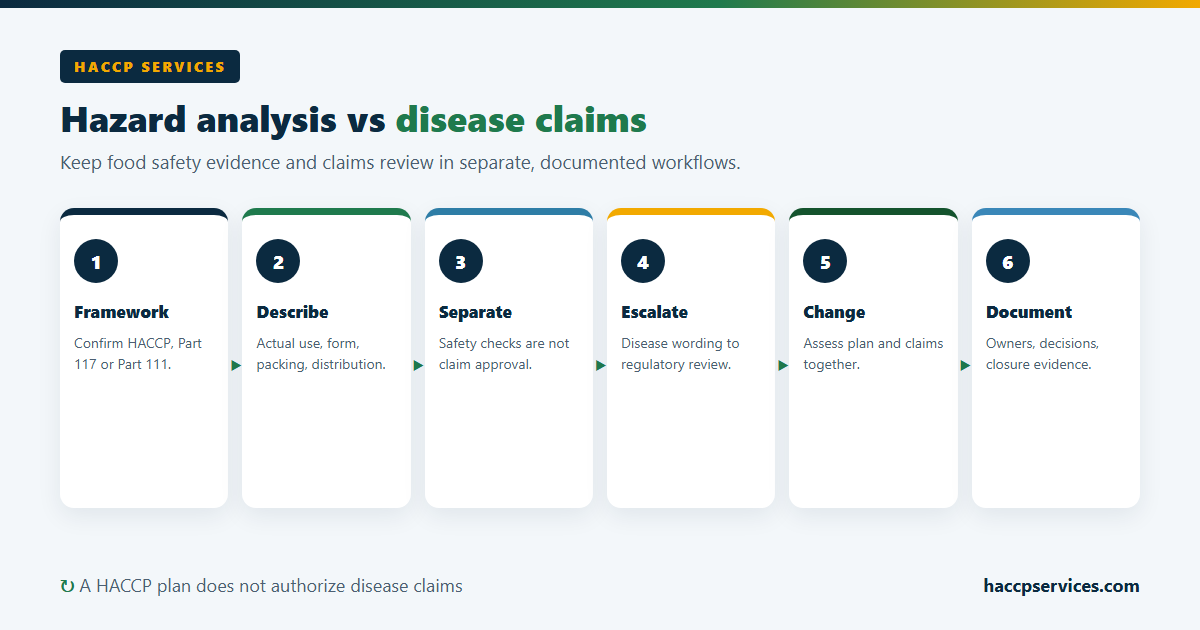
4. Control technical wording shared with marketing
Technical teams often supply scientific descriptions for product information. Review that wording for accuracy. At the same time, escalate any disease-related claim to qualified regulatory personnel before it is published. FDA’s guidance on structure/function claims is a useful starting point for that review.
5. Manage relevant changes systematically
Formulation, processing, intended use and distribution can all change. When they do, evaluate the effect on the food safety plan and, separately, on the claims-review process. A structured process change impact assessment helps make sure neither review is skipped.
6. Document findings and corrective action
Finally, record an owner and closure evidence for every discrepancy. This applies to errors in food safety descriptions and to issues with approved promotional language. Keep each record in the system it belongs to, and use controlled document versions to show what was approved and when.
Frequently asked questions
Does a HACCP plan permit a supplement to make disease claims?
No. Hazard control and intended-use classification are separate regulatory questions. A HACCP plan does not authorize supplement disease claims.
Are all dietary supplements subject to mandatory HACCP?
No. Applicability depends on the product and the operation. Dietary supplements have their own CGMP framework under 21 CFR Part 111.
Can an ingredient safety study substantiate a therapeutic claim?
No. Evidence that supports safety or manufacturing controls is not FDA authorization to market a product as a drug.
Supplement disease claims checklist
- Identify the hazard-control rules that actually apply to the product.
- Keep food safety documentation separate from marketing authorization decisions.
- Review product descriptions for consistency with the process and intended use.
- Escalate treatment and prevention claims before publication.
- Track technical and promotional changes through documented review.
How HACCP Services can help
HACCP Services, a service of Consultare Inc. Group, supports HACCP applicability assessments, hazard analysis and plan review, food safety record evaluation, change management and corrective action procedures. Deliverables depend on the specific product, operation and agreed engagement.
- HACCP plan development
- Food safety change management
- HACCP document control
- Corrective action management
Need help with your HACCP responsibilities?
Discuss your products, current documentation and regulatory questions with our team. You can book a free consultation or contact our team.
Start building your compliance system
If you prefer to organize and manage your compliance activities yourself, you can also create a free SystemsBuilder account. Then begin building a structured system for your compliance documentation and processes.
Technical sources: 21 U.S.C. 321(g)(1), 21 CFR 101.93, 21 CFR Part 111 and FDA Structure/Function Claims. This article is educational; HACCP Services is not affiliated with FDA, and specific requirements depend on your products, processes and applicable regulations.