
Critical control points and critical limits only work when they follow from a product-specific hazard analysis and are backed by scientific evidence. A critical control point (CCP) is a step where control can be applied and is essential to prevent, eliminate or reduce a food safety hazard to an acceptable level. A critical limit separates acceptable from unacceptable operation at that point.
Not every hazard or process step should automatically become a CCP. Instead, the analysis must fit the product, process, hazard and regulatory framework. FDA mandates HACCP plans for juice (21 CFR Part 120) and seafood (Part 123), and USDA FSIS does so for meat and poultry (9 CFR Part 417). Many other FDA-regulated facilities operate under preventive controls in 21 CFR Part 117 rather than a traditional HACCP plan.
Who this article is for
This guide is written for HACCP coordinators, quality managers, food safety teams and suppliers, including those preparing for retailers such as Costco, who need to set or review CCPs and critical limits.
1. Complete the hazard analysis before selecting CCPs
First, identify biological, chemical, physical and allergen hazards that are reasonably likely to occur. Then evaluate their significance using product and process information. Our HACCP hazard analysis page explains the method.
Next, consider whether a hazard is controlled at a particular step, through a prerequisite program, through a supply-chain control or through another preventive measure. Avoid assigning CCPs simply to make a plan look more comprehensive.
2. Use a consistent decision process
Evaluate whether a control measure is essential at the step and whether loss of control could lead to an unacceptable food safety risk. Use a recognized decision approach, and document the rationale for each CCP decision.
Also consider upstream and downstream controls, the nature of the hazard and actual operating conditions. A decision tree is a tool, not a substitute for competent hazard analysis. For more detail, see HACCP critical control points.
3. Establish scientifically supported critical limits
Critical limits should be measurable or observable. They should also be supported by scientific, regulatory or other technically appropriate evidence. Examples include time, temperature, pH, water activity or other process-specific parameters.
Confirm that each limit applies to the product, equipment, process configuration and operating range. Never copy a limit from another product without verifying its technical suitability. Under Part 117, process controls must likewise include the maximum or minimum values a parameter must be controlled to, as appropriate (21 CFR 117.135(c)(1)). See HACCP critical limits.
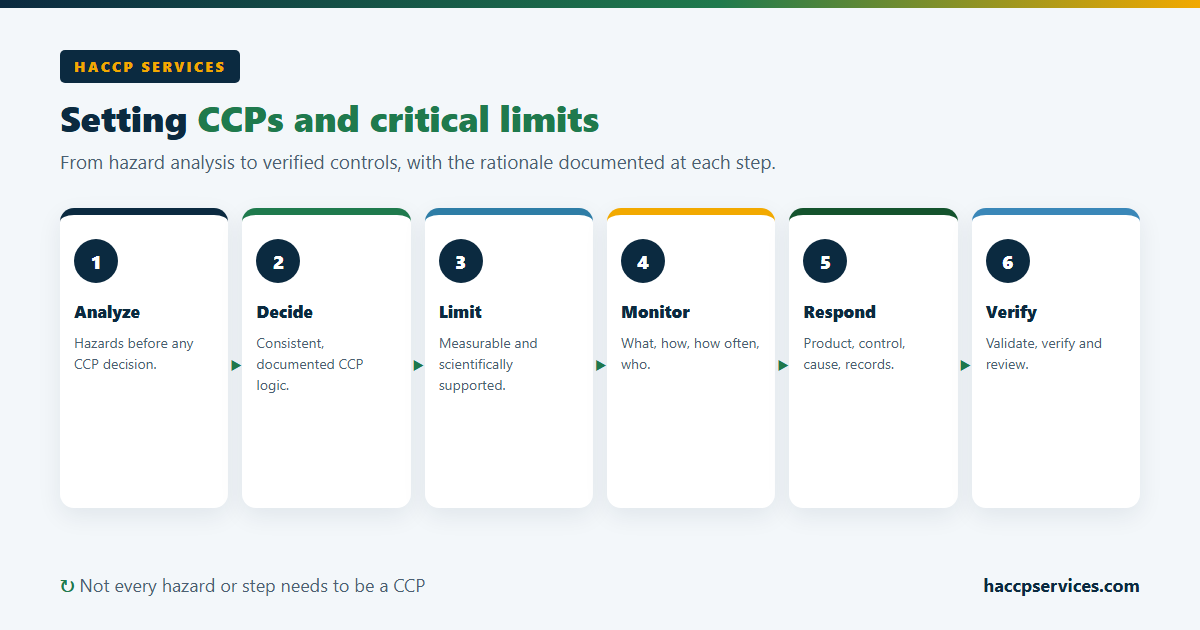
4. Define monitoring and deviation response
Specify what is monitored, how it is measured, how often it is checked, who performs the check and how results are recorded. Monitoring should detect loss of control in time for appropriate action. See HACCP monitoring procedures.
Then define what happens when a critical limit is not met. The response should address affected product, restoration of control, evaluation of the cause and required documentation. The regulations set this out, for example, in 21 CFR 120.10, 123.7 and 9 CFR 417.3, and in 21 CFR 117.150 for preventive controls.
5. Verify, validate and review the HACCP system
Validation asks whether the control measure can control the hazard. Verification, by contrast, checks whether the system is being implemented as intended. These are different activities, so document them separately where required (for example, 21 CFR 117.160 and 117.165).
Review monitoring records, calibration, corrective actions, internal audits and changes to ingredients or processes. In addition, reassess the plan when changes or new information could affect the hazard analysis. See HACCP verification and validation.
6. Keep regulatory and customer expectations distinct
Some sectors have specific HACCP regulations, while other FDA-regulated food facilities may be subject to preventive controls under 21 CFR Part 117. Therefore, determine the correct framework for the product and operation first.
Retailer specifications may request particular evidence or formats. Confirm current Costco requirements with the relevant buyer, and do not describe a customer preference as a federal legal requirement.
Frequently asked questions
Does every hazard need a CCP?
No. Many hazards are controlled through prerequisite programs, supply-chain controls or other preventive measures. A CCP is only needed where control at that step is essential.
What is the difference between validation and verification?
Validation shows that a control measure is capable of controlling the hazard. Verification shows that the system is being carried out as planned.
Can we use a critical limit from a published example?
Only after confirming it is technically suitable for your product, equipment, process configuration and operating range.
CCP and critical limit checklist
- Identify hazards before deciding whether a CCP is needed.
- Document the rationale for each CCP decision.
- Support critical limits with appropriate technical evidence.
- Define monitoring responsibilities and frequency.
- Establish product disposition and corrective action procedures for deviations.
- Separate validation from verification and retain records.
- Review the plan when process or hazard information changes.
How HACCP Services can help
HACCP Services, a service of Consultare Inc. Group, supports HACCP plan reviews, hazard analysis, CCP decision documentation, critical limit evidence review, monitoring and corrective action procedure development, and internal audit preparation, subject to the engagement scope.
- HACCP plan development
- HACCP plan validation and scientific justification
- CCP monitoring system design
- HACCP regulatory compliance audits
Are your HACCP critical limits technically supported?
Review your hazard analysis, CCP decisions, critical limits and monitoring records with our team. You can book a free consultation or contact our team.
Start building your compliance system
If you prefer to organize and manage your compliance activities yourself, you can also create a free SystemsBuilder account. Then begin building a structured system for your compliance documentation and processes.
Technical sources: Codex Alimentarius General Principles of Food Hygiene (CXC 1-1969), FDA Hazard Analysis Critical Control Point (HACCP), FDA Fish and Fishery Products Hazards and Controls Guidance, FDA Juice HACCP Hazards and Controls Guidance and 21 CFR Part 117. This article is educational; HACCP Services is not affiliated with or endorsed by FDA, USDA or Costco Wholesale. Costco-specific supplier requirements must be confirmed directly with the relevant Costco contact, and regulatory applicability depends on your product, facility, activities and current law.