
A hazard analysis for new food products should be completed, or reassessed, for the actual product and process before routine commercial production starts. New ingredients, suppliers, processing conditions, packaging, shelf life and distribution can all change the food safety picture. For that reason, an analysis copied from an unrelated product is not a reliable starting point.
Manufacturers preparing products for large retailers, such as Costco, benefit from building food safety into product development early. However, the legal framework depends on the product and operation. Juice and seafood processors follow FDA HACCP rules in 21 CFR Part 120 and Part 123. Meat and poultry establishments follow USDA FSIS rules in 9 CFR Part 417. Most other FDA-registered food facilities fall under the preventive controls rule in 21 CFR Part 117.
Who this article is for
This guide is written for food manufacturers, product development teams, quality and regulatory staff, and suppliers preparing a new product for retail distribution.
1. Define the product and its intended use
Start by documenting the product’s composition, relevant characteristics, packaging, storage conditions and shelf life. Also record preparation instructions, the intended consumer and reasonably foreseeable use. Note whether the product is ready-to-eat, requires cooking or is intended for further processing.
Next, identify vulnerable consumer groups where relevant. Then assess whether the intended use, or foreseeable misuse, changes the hazard evaluation. Under 21 CFR 117.130(c)(2), for example, the hazard evaluation must consider factors such as formulation, raw materials, packaging and labeling, storage and distribution, and intended or reasonably foreseeable use.
2. Map every processing step
Develop a process flow from receiving through storage, preparation, processing, packaging, finished-product handling and distribution. Include rework, hold steps, outsourced processes and any relevant transport or storage activities.
After that, verify the flow diagram on site or through a documented review of the actual process. Changes in equipment, line configuration or process sequence may affect the analysis.
3. Identify and evaluate biological, chemical, physical and allergen hazards
Review hazards linked to raw materials, ingredients, the processing environment, equipment, personnel, packaging and distribution. Consider known or reasonably foreseeable hazards, and decide whether each one requires control under the applicable framework. Part 117 facilities, for instance, must write the hazard analysis regardless of its outcome (21 CFR 117.130).
Support every decision with reliable scientific, regulatory, supplier and process information. In addition, do not dismiss a hazard solely because the facility has never had a problem with it. Our HACCP hazard analysis page explains the method in more detail.
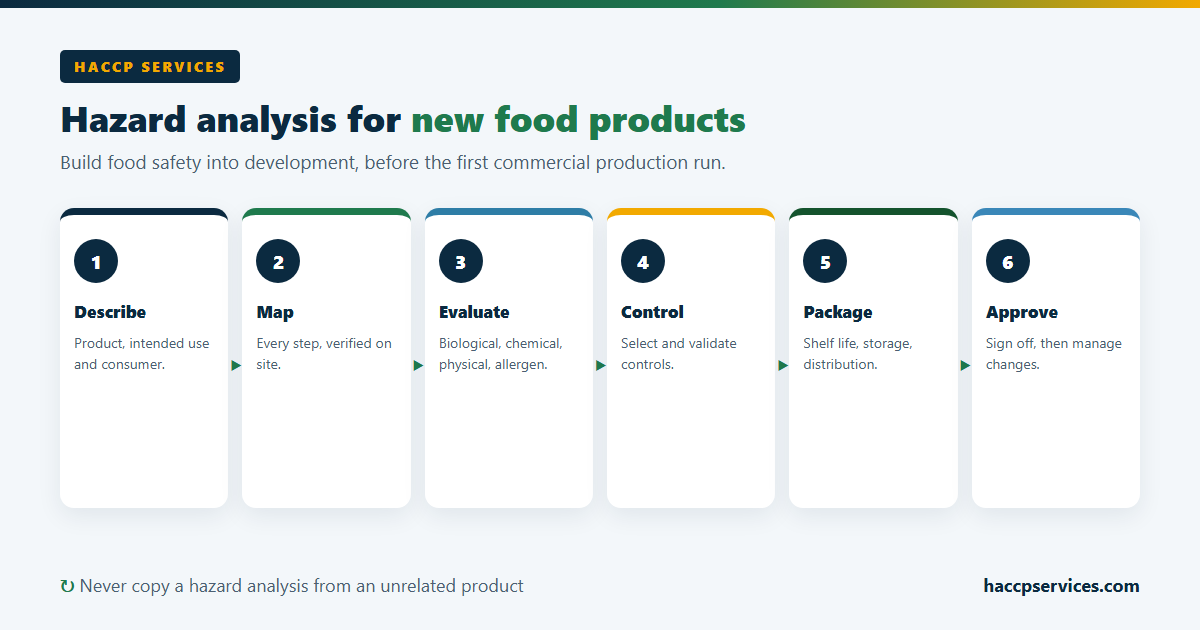
4. Select and validate appropriate controls
Decide whether each hazard will be controlled through process controls, sanitation controls, allergen controls, supply-chain controls or other measures. For HACCP-regulated operations, determine whether critical control points and critical limits are required.
Where validation is required, gather evidence that the selected control can control the hazard under actual conditions of use. Under 21 CFR 117.160, for example, validation includes obtaining and evaluating scientific and technical evidence. Never use a generic critical limit without a product- and process-specific basis. See HACCP verification and validation.
5. Review packaging, shelf life and distribution conditions
Assess whether packaging protects the product and whether the seal or closure is suitable. Then check that storage and transport conditions maintain product safety. Review shelf-life support and foreseeable temperature or handling deviations.
Finally, confirm that labels and handling instructions match the product’s actual safety characteristics and applicable requirements.
6. Approve the product before routine production
Set up a documented review and approval process involving product development, operations, quality and regulatory personnel. Before routine commercial production, confirm that the process flow, hazard analysis, control measures, monitoring, verification and records are ready.
Reassess the analysis whenever ingredients, suppliers, formulation, equipment, process parameters, packaging or intended use change. For Part 117 facilities, 21 CFR 117.170 requires reanalysis when a significant change creates a reasonable potential for a new hazard. Our article on imported ingredient supplier controls covers one common source of change.
Frequently asked questions
Can we reuse the hazard analysis from a similar product?
Only as a reference. The analysis must reflect the new product’s actual ingredients, process, packaging, intended use and distribution.
Does every new product need a HACCP plan?
Not necessarily. Juice, seafood, and meat and poultry have specific HACCP regulations. Many other FDA-registered facilities instead need a food safety plan with preventive controls under 21 CFR Part 117, prepared or overseen by a preventive controls qualified individual (21 CFR 117.126).
Does a hazard analysis guarantee acceptance by a retailer such as Costco?
No. A sound hazard analysis supports supplier readiness, but retailer requirements must be confirmed directly with the relevant buyer or Costco contact.
Supplier readiness checklist
- Approve the product description and intended-use information.
- Verify the complete process flow.
- Evaluate biological, chemical, physical and allergen hazards.
- Select controls under the applicable regulatory framework.
- Validate controls where required and document the basis.
- Assess packaging, shelf life, storage and distribution.
- Approve the plan and maintain it through change control.
How HACCP Services can help
HACCP Services, a service of Consultare Inc. Group, supports product-specific hazard analysis, process flow verification, HACCP plan development, preventive controls assessment, validation planning and pre-production food safety reviews, subject to the engagement scope.
- New product and process change impact assessment
- HACCP plan development
- HACCP plan validation and scientific justification
- Food safety change management
Launching a new food product or changing an existing process?
Review your formulation, process flow, ingredients, packaging and hazard controls with our team. You can book a free consultation or contact our team.
Start building your compliance system
If you prefer to organize and manage your compliance activities yourself, you can also create a free SystemsBuilder account. Then begin building a structured system for your compliance documentation and processes.
Technical sources: FDA FSMA Final Rule for Preventive Controls for Human Food, 21 CFR Part 117, FDA Juice HACCP Hazards and Controls Guidance, FDA Fish and Fishery Products Hazards and Controls Guidance and 9 CFR Part 417 (USDA FSIS HACCP). This article is educational; HACCP Services is not affiliated with or endorsed by FDA, USDA or Costco Wholesale. Costco-specific supplier requirements must be confirmed directly with the relevant Costco contact, and regulatory applicability depends on your product, facility, activities and current law.